
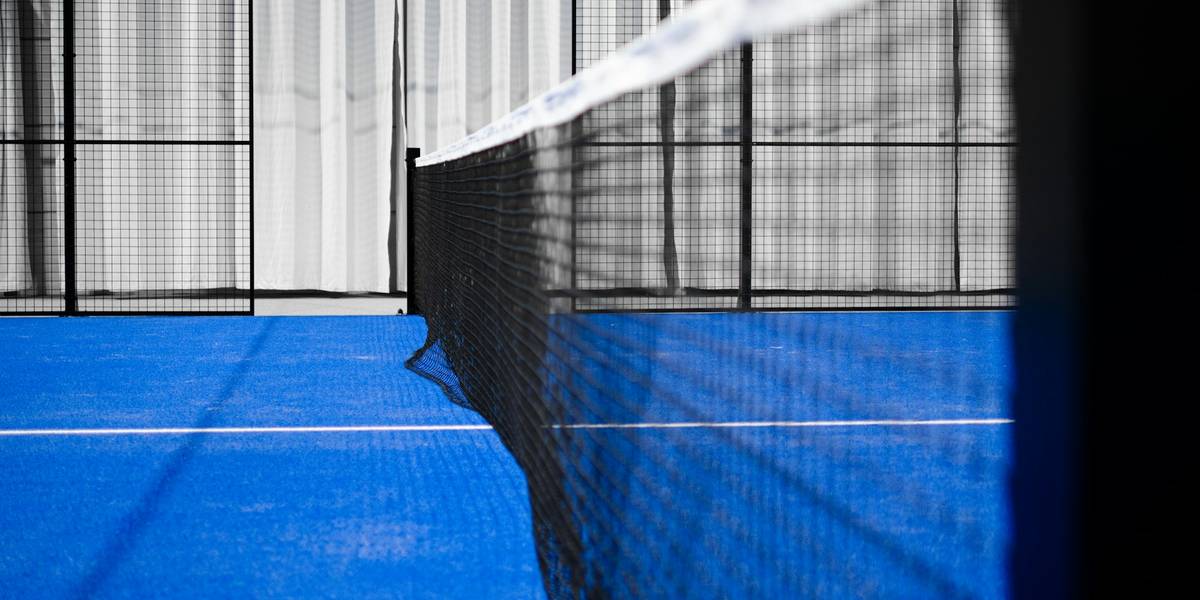
A padel court is the most distinctive thing about the sport — a fully enclosed glass-and-mesh box, exactly 20 metres long by 10 metres wide, where the walls are part of the game rather than just a boundary. If you have only ever watched, the size and layout can be confusing, so here is the complete breakdown: official dimensions in both metres and feet, net and service-line measurements, what the glass and mesh walls do, and how a padel court compares to a tennis or pickleball court.
Every figure below follows the International Padel Federation (FIP) regulations, which set the standard for clubs and tournaments worldwide.
The short version: a padel court is 20 m × 10 m (about 65.6 × 32.8 ft), enclosed by 3–4 m glass and mesh walls, with a net 0.88 m high at the centre. New to the game? Start with what padel is and how to play, then find a court near you in the US.
Padel court dimensions at a glance
Here are the official FIP measurements, in metric and imperial:
| Measurement | Metric | Imperial (approx.) |
|---|---|---|
| Total court (length × width) | 20 m × 10 m | 65.6 ft × 32.8 ft |
| Playing area | 200 m² | ~2,150 sq ft |
| Net height (centre) | 0.88 m | 2 ft 11 in |
| Net height (at the posts) | 0.92 m | 3 ft 0 in |
| Service line (distance from net) | 6.95 m | 22 ft 10 in |
| Back wall height | 4 m (3 m glass + 1 m mesh) | 13.1 ft |
| Side wall height | up to 3–4 m | 9.8–13.1 ft |
| Line width | 5 cm | 2 in |
| Overhead clearance (indoor) | min. 6 m | 19.7 ft |
A small tolerance of ±0.5% is permitted on the court dimensions. Note that the height figures are why padel needs serious overhead room indoors — lobs are a core tactic.
How big is a padel court? (20 m × 10 m)
A padel court is a rectangle 20 metres long and 10 metres wide, split into two 10 m × 10 m halves by the net. That makes it roughly a quarter the size of a doubles tennis court (which is about 23.77 m × 10.97 m), which is exactly why padel is almost always played as doubles — the compact space rewards quick reactions and teamwork over raw court coverage.
Because the court is small and walls keep the ball in play, rallies last far longer than in tennis. If you are coming from another racket sport, our guides to padel vs tennis and padel vs pickleball explain how the smaller court changes the game.
Padel court walls: glass and mesh
The walls are what make padel unique — unlike tennis, the ball stays live after it rebounds off them. There are two surfaces, and they behave very differently:
- Glass walls (the back and part of the sides). Solid up to 3 m, made of toughened glass. They give a clean, predictable rebound, so you can let a hard shot pass, take it off the glass, and play it back. This is the skill that defines padel.
- Metal mesh (the top metre and upper sides). The fencing completes the enclosure up to 4 m at the ends. The ball can come off the mesh in a rally, but it bounces irregularly — and you may not use the mesh on the serve.
Learning to read the rebound off the back glass is the single biggest difference for newcomers. We cover the tactics in how to play padel.
The net and service lines
The net runs across the middle, 0.88 m high at the centre and 0.92 m at the posts — slightly lower in the middle, like tennis. The only lines that actually matter are the service lines, set 6.95 m back from the net on each side, and the centre service line that splits each half into two service boxes.
Crucially, there are no other lines in play: away from the serve, a ball is good as long as it lands inside the court, wherever that is. All lines are 5 cm wide.
Padel court dimensions in feet (for US readers)
Most US clubs build to the metric FIP standard, but here are the key numbers converted to feet:
- Court size: about 65.6 ft long × 32.8 ft wide
- Net height: 2 ft 11 in at the centre
- Service line: 22 ft 10 in from the net
- Wall height: up to 13 ft at the back
- Playing area: roughly 2,150 sq ft
Indoor vs outdoor and court types
Courts come in a few variations, but the playing dimensions never change:
- Indoor vs outdoor. Identical court size; indoor courts simply need at least 6 m of overhead clearance for lobs.
- Traditional vs panoramic. Panoramic courts remove the metal posts from the glass for an unbroken view — popular for spectators and broadcasts — but play the same.
- Single (1v1) courts. A narrower 20 m × 6 m version exists for singles, but the standard 20 m × 10 m doubles court is by far the most common.
Padel court vs tennis and pickleball courts
Padel sits between tennis and pickleball in size — bigger than a pickleball court, much smaller than tennis, and the only one of the three with walls in play:
| Court | Dimensions | Playing area | Walls in play? |
|---|---|---|---|
| Padel | 20 m × 10 m | 200 m² | Yes |
| Tennis (doubles) | 23.77 m × 10.97 m | ~261 m² | No |
| Pickleball | 13.4 m × 6.1 m | ~82 m² | No |
For the full breakdown of how the sports differ, see padel vs pickleball vs paddle tennis.
How much does a padel court cost to build?
A standard padel court costs roughly $20,000–$50,000+ to build in the US depending on surface, glass quality, lighting and whether it is indoor or outdoor. If you are considering installing one, we walk through the full process — surfaces, permits, costs and maintenance — in our guide to building a padel court.
The bottom line
A padel court is a compact, walled 20 m × 10 m arena where the glass is part of the game — and that enclosed design is exactly what makes padel so addictive and easy to pick up. Ready to play? Brush up on the rules, learn how to play, grab a racket from our best padel rackets guide, and find a court near you.
Frequently asked questions
A padel court is 20 metres long and 10 metres wide (about 65.6 × 32.8 ft) — roughly a quarter of the size of a doubles tennis court, which is why padel is played as doubles.
Approximately 65.6 ft long by 32.8 ft wide, with a net 2 ft 11 in high at the centre and the service lines 22 ft 10 in from the net.
0.88 metres (2 ft 11 in) at the centre and 0.92 metres (3 ft) at the posts — slightly lower in the middle, like a tennis net.
Yes. After the ball bounces on the floor it can rebound off the glass walls and stay in play — using the back glass is a core padel skill. The ball may also come off the metal mesh in a rally, but it bounces unpredictably.
Yes, much smaller — about 200 m² versus roughly 261 m² for a doubles tennis court, and fully enclosed by walls.

Lucas Sánchez is the founder of SimplePadel. Born and raised in Spain, Lucas has been living in the US and UK for the last 20 years and currently calls Miami his home. While he’s never played professionally, the dream is still alive.
Lucas loves nothing more than playing (and talking) about padel, and he considers himself lucky to have a wife and family that share his love for the game.