
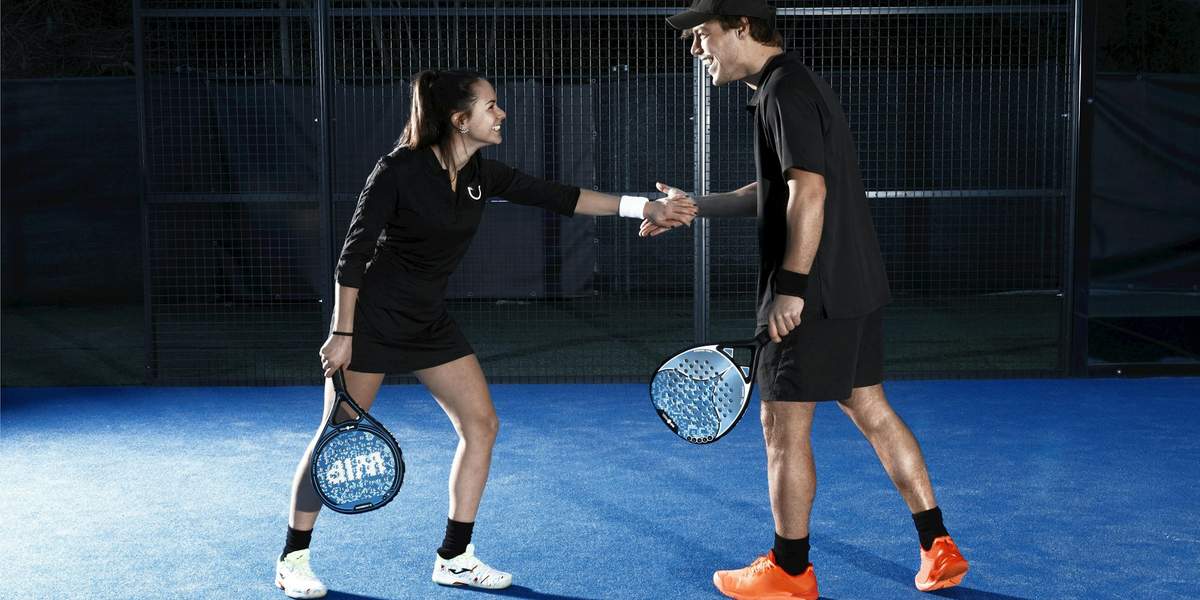
Padel rules are refreshingly simple — if you have ever watched tennis, you already know most of them. The scoring is identical, and the few things that make padel different (an underhand serve, and the fact that you can play the ball off the glass walls) are exactly what make it so much fun and so easy to pick up. This is the complete, beginner-friendly guide to how padel works, based on the official International Padel Federation (FIP) rules.
The 30-second version: padel is played as doubles, scored exactly like tennis (15–30–40–game), the serve is underhand and diagonal, and the ball stays live off the glass walls. New to it all? See what padel is, the padel court explained, and how to play. For the deciding-point formats, see the golden point and the padel tiebreak.
Padel rules at a glance
- Format: almost always doubles (two vs two) on an enclosed 20 m × 10 m court.
- Scoring: same as tennis — 15, 30, 40, game; six games win a set; best of three sets.
- Serve: underhand, hit below waist height after one bounce, diagonally into the opposite service box.
- Walls: after the ball bounces on the floor, it can rebound off the glass and stay in play.
- Winning a point: your opponents fail to return the ball before it bounces twice, or they hit it out / into the net.
How padel scoring works
Padel uses the exact tennis scoring system. Each point won moves you up the ladder:
| Points won | Score called |
|---|---|
| 0 | Love |
| 1 | 15 |
| 2 | 30 |
| 3 | 40 |
| 4 (win by 2) | Game |
If both teams reach 40–40 it is deuce: a team must then win two points in a row to take the game (the first is “advantage”). Many clubs and all professional events instead use a faster sudden-death point at deuce — long called the golden point, and updated by the FIP to the Star Point format for 2026 — where a single point decides the game.
Six games win a set (you must lead by two; at 6–6 a tie-break to 7 is played), and the first team to two sets wins the match.
The padel serve — the rule that trips up newcomers
The serve is where padel differs most from tennis. There is no power overhand serve; it is deliberately gentle so rallies can build. The rules:
- Stand behind the service line, with both feet between the centre line and the side wall.
- Bounce the ball once on the floor first, then strike it.
- Contact must be at or below waist height (underhand).
- Serve diagonally into the opposite service box, just like tennis.
- You get two serves. After the bounce in the box, the ball may hit the side glass and stay good — but if it touches the metal fence, it is a fault.
There is a lot of nuance here — foot positioning, illegal serves, the let, and recent FIP tweaks — so we cover it fully in our dedicated guide to the padel serve rules.
Playing off the walls
This is the skill that makes padel feel different from every other racket sport. The key principle: the ball must bounce on the floor first, and after that it is fair game off the walls.
- Your own walls: if a shot flies past you, let it hit your back glass, then play it back over the net after the rebound. Totally legal and a core tactic.
- Glass = predictable. The smooth glass gives a clean, readable bounce you can plan for.
- Hitting the opponent’s wall on the full = your point. If you strike the ball and it hits their wall or fence before bouncing on their floor, you lose the point.
- Out: a ball that leaves the court (over the glass/fence) or hits the surrounding structure is out.
Here are the specific wall and glass situations that cause most on-court arguments.
Ball hitting your own wall or glass before going over the net
If you hit a shot and the ball clips your own back wall or side glass before crossing the net, the point is immediately over — your opponents win it. The ball must travel directly from your racket, over the net, and into the opponents’ side. Any contact with your own court’s walls before crossing the net is an automatic fault.
Ball hitting the opponent’s wall or glass after going over
Completely valid. Once the ball crosses the net, it can bounce on the floor and then interact with the opponent’s walls, glass, and fences as much as it likes — as long as it only bounces once on the floor before they play it. This is what creates padel’s famous comeback shots where a player runs out through an open gate and returns a ball that’s bounced off the back glass.
Ball bouncing twice before hitting a wall
Once the ball bounces twice on the floor on your side, the point is over and your opponents win it. The second bounce ends the rally — it doesn’t matter if the ball then hits a wall. The wall interaction only matters after the first bounce, not the second.
Ball bouncing on the floor-wall angle — the “huevo”
This is one of padel’s most debated situations. When the ball hits the junction between the court floor and the back glass at a very low angle — called a “huevo” (egg) in Spanish — it can be genuinely difficult to tell whether it hit the floor or the glass first. The key indicators are trajectory (a higher rebound angle suggests floor first; a very low, fast rebound suggests glass first) and spin (floor contact creates backspin; glass contact produces topspin). Without a referee, players call it by mutual agreement using these clues.
Ball going through a gap in the fence
If the ball passes through a gap or hole in the fence during play — a structural issue with the court rather than something either team caused — the official rule is that it’s treated as a let and the point is replayed. If there is a referee present, it’s their call. In recreational play, the convention is the same: replay the point. Neither team loses the point for a court maintenance issue.
The bounce rules in detail
The bounce rules are the heart of padel’s wall game. Getting these right removes most of the ambiguity from disputed points.
- One bounce, then walls are fine: the ball must bounce once on the court floor. After that single bounce, it can hit the back glass, side glass, or fence on your side, and the ball is still in play. You can hit it off the back wall — that’s valid padel.
- Two bounces = point over: if the ball bounces a second time before you play it, the rally ends. Your opponents win the point. There is no saving it off a wall after the second bounce.
- Ball bounces once, hits a wall, and you can still play it: perfectly valid. Get there, play it. This is where padel’s physicality shines — and why good footwork is so essential to the game.
- Ball bounces and goes over the fence without being struck: this happens on powerful smashes. The point ends if the ball bounces on the floor and then goes over the back fence — your opponents win the point because the ball cannot be played once it exits the court without being struck. However, if the court has an exit gate and the ball bounces close to the fence, players can exit to play it before that second situation occurs.
Net cord and let rules
The net plays a smaller role than in tennis, but there are still situations players get wrong regularly.
- Ball clips the net during a rally and lands in: valid — play continues. A lucky net cord is perfectly legal in padel, just like in tennis. Your opponents must play the ball.
- Service let (ball clips net on serve and lands in the correct box): the serve is replayed. You get to take the same serve again — first or second, whichever it was. Note: if the ball clips the net and lands outside the service box, it’s a fault, not a let.
- Ball hits the net post and goes over: valid — the net post is part of the net structure. If the ball clears the post and lands in the opponents’ court legally, it’s in play.
- Let called during a rally: the most common causes are a ball from another court rolling onto yours, a player distracted by external interference, or a ball splitting during play. In all cases, the point is replayed from the serve.
Ball going out through open doors or fence gaps
Padel courts have gates that players can exit through to retrieve balls that go over the fence — this is one of padel’s most spectacular features and a genuine tactical element at higher levels. Here are the key rules:
- Ball exits through the open gate intentionally (the gate was already open): the defending team is allowed to exit the court and play the ball from outside — but only their own gate on their half of the court. You cannot run around to the other team’s gate.
- Ball exits through a gap caused by a player (e.g., a door that opens on impact): referee’s discretion. Generally treated as a fault or let depending on whether it was foreseeable. In casual play, a let is the most common resolution.
- Ball exits through an unintentional structural gap: let, point replayed. The serving rules also apply here — if it’s a serve that exits through a gap, it’s replayed.
Player touching the net or post
This is a strict rule with no grey area: any contact between a player, their racket, or their clothing and the net or post during a live point results in an immediate loss of that point. It doesn’t matter if it was accidental, if the ball had already passed, or if the contact was with the post rather than the net tape itself.
The only exception: if the ball has already bounced twice on the opponents’ side — meaning the point is already over in your favour — and you then touch the net, there’s no penalty because the point had already concluded.
Key things to watch for near the net:
- Racket swinging through and grazing the net tape
- Reaching over the net to play a ball that hasn’t yet crossed (automatic fault — also covered below)
- Clothing (shirt, sleeve) brushing the net when lunging for a shot
- Sliding into the net post during a wide volley
Hindrance and obstruction rules
Hindrance situations arise when a player is prevented from playing a shot by something outside the normal course of the game. In organised play with a referee, the referee decides. In casual play, it’s handled by mutual agreement.
- Deliberate hindrance (e.g., a player shouts, waves, or moves to distract an opponent mid-shot): the player causing the hindrance loses the point. This is unsportsmanlike conduct and treated seriously in competitive play.
- Unintentional hindrance (e.g., a ball rolls onto the court from an adjacent game, a player stumbles into the path of an opponent): let called, point replayed. No penalty to either team.
- Player drops a spare ball from their pocket during a rally: the opposing team can call a let and replay the point. This is explicitly covered in the FIP rules — it’s a legitimate let situation.
The golden point rule also applies here — at deuce in club play, the golden point is played even when a let was just called on the preceding point. Understanding the golden point rule prevents a lot of end-of-game arguments.
When do you win or lose a point?
A point ends — and you win it — when the opposing team:
- lets the ball bounce twice on their side;
- hits the ball into the net;
- hits the ball out of the court or directly into their own wall/fence before it bounces;
- is struck by the ball, or touches the net with body or racket while the ball is live;
- hits the ball twice or carries it.
Common disputed points — quick reference table
Here are the situations that cause arguments most frequently, with clear verdicts:
| Situation | Valid or fault? | Rule |
|---|---|---|
| Ball bounces on floor then hits back glass — opponents return it | Valid | Bounce + wall = in play |
| Ball hits glass before bouncing on floor | Fault — opponents win point | Must bounce on floor first |
| Ball bounces twice before hitting wall | Fault — opponents win point | Two bounces ends the rally |
| Serve clips the net, lands in correct box | Let — replay the serve | Service let rule |
| Player’s racket clips the net during a volley | Fault — opponents win point | Net contact rule |
| Ball exits through open gate, opponent plays it from outside | Valid | Out-of-court play allowed (own side only) |
| Overhead smash bounces on floor and clears the back fence | Opponents win the point | Ball unplayable once it exits |
| Ball hits the top of the fence (metallic edging) on opponents’ side | Fault — your team wins point | Top of fence = out |
| Ball hits the net post and crosses into opponents’ court | Valid | Net post is part of the net structure |
| You reach over the net to play a shot before it crosses | Fault — opponents win point | Ball must cross net before you can play it |
| Player drops a spare ball from pocket during a rally | Let — replay the point | FIP hindrance rule |
Deciding points: golden point and the tiebreak
Two situations decide a game or a set outright, and both have rules worth knowing before your first club match.
- At 40–40: traditional scoring plays advantage, but most clubs and every professional event use a single sudden-death point instead, with the receiving team choosing which side takes it. Full detail in our guide to the golden point in padel.
- At 6–6 in games: a tiebreak to seven points (win by two) decides the set, with serve changing after the first point and then every two points. See how a padel tiebreak works.
Padel rules vs tennis rules
If you play tennis, here is everything that is different — and everything that is the same:
| Element | Padel | Tennis |
|---|---|---|
| Scoring | 15/30/40, sets, tie-break | Same |
| Serve | Underhand, below waist | Overhand, powerful |
| Walls | Played off the glass | No walls |
| Format | Almost always doubles | Singles or doubles |
| Court | 20 m × 10 m, enclosed | Larger, open |
See the full comparison in padel vs tennis.
The bottom line
Padel rules boil down to tennis scoring, an underhand serve, and walls you can play off — learn those three things and you can start playing today. Next, get the detail on the serve, see the court explained, read how to play padel, and pick up a paddle from our best padel rackets guide.
Frequently asked questions
Exactly like tennis: points go 15, 30, 40, game; you need six games (winning by two) to take a set, with a tie-break at 6–6, and the first team to two sets wins. At deuce, many clubs and all pro events use a single sudden-death point.
To keep rallies long and the game accessible. The server must bounce the ball once, then hit it below waist height, diagonally into the service box — there is no power serve, so points are won through rallies rather than aces.
Yes — after it bounces on the floor first. You can let a ball pass, take it off your own back glass, and play it back. Using the walls is the core skill that sets padel apart.
A sudden-death point played at deuce (40–40) where a single point wins the game instead of having to win by two. It speeds up matches and is standard at professional events (updated to the FIP “Star Point” format for 2026).
Almost always. The court is small (20 m × 10 m), which makes doubles the natural format. Singles is possible on a narrower court but is rare.
No — the ball must bounce on the court floor first. If it hits the back wall or glass before bouncing, the point is a fault and the opposing team wins it. This is one of the most fundamental rules in padel. The sequence must always be: net → floor bounce → then walls or fence on your side.
If the ball passes through a gap or structural opening in the fence due to a court maintenance issue, the point is typically replayed as a let. If it exits through an open gate, players on the receiving side may exit to play the ball from outside the court — but only through their own side’s gate. If a gate opens due to player contact during a rally, referee’s discretion applies; in casual play, a let is the usual outcome.
Yes — the top of the fence (the metallic upper frame or edging) counts as out. If the ball hits that top frame on the opponents’ court without bouncing on the floor first, your team wins the point. If it hits the top frame on your side during a rally, your opponents win the point.
Yes — volleys are allowed and are an important part of the game, especially at the net. The key restriction: you cannot volley a ball before it has crossed to your side of the court. Reaching over or through the net to play the ball before it crosses is a fault. Also, you cannot volley on the serve — the ball must bounce once in the service box before the receiver plays it.
A fault serve occurs when: the ball doesn’t land in the correct diagonal service box; the server steps on or over the service line or imaginary centre line; the server jumps during the serve; the ball hits the fence or back wall before bouncing; or the ball bounces outside the service box lines. Two consecutive faults means a double fault and the opponents win the point.
Any contact between your body, racket, or clothing and the net or net post during a live point means you lose that point immediately. There are no exceptions for accidental contact. The only scenario where net contact doesn’t matter is if the ball has already bounced twice on the opponents’ side — meaning the point was already over before the contact occurred.

Lucas Sánchez is the founder of SimplePadel. Born and raised in Spain, Lucas has been living in the US and UK for the last 20 years and currently calls Miami his home. While he’s never played professionally, the dream is still alive.
Lucas loves nothing more than playing (and talking) about padel, and he considers himself lucky to have a wife and family that share his love for the game.