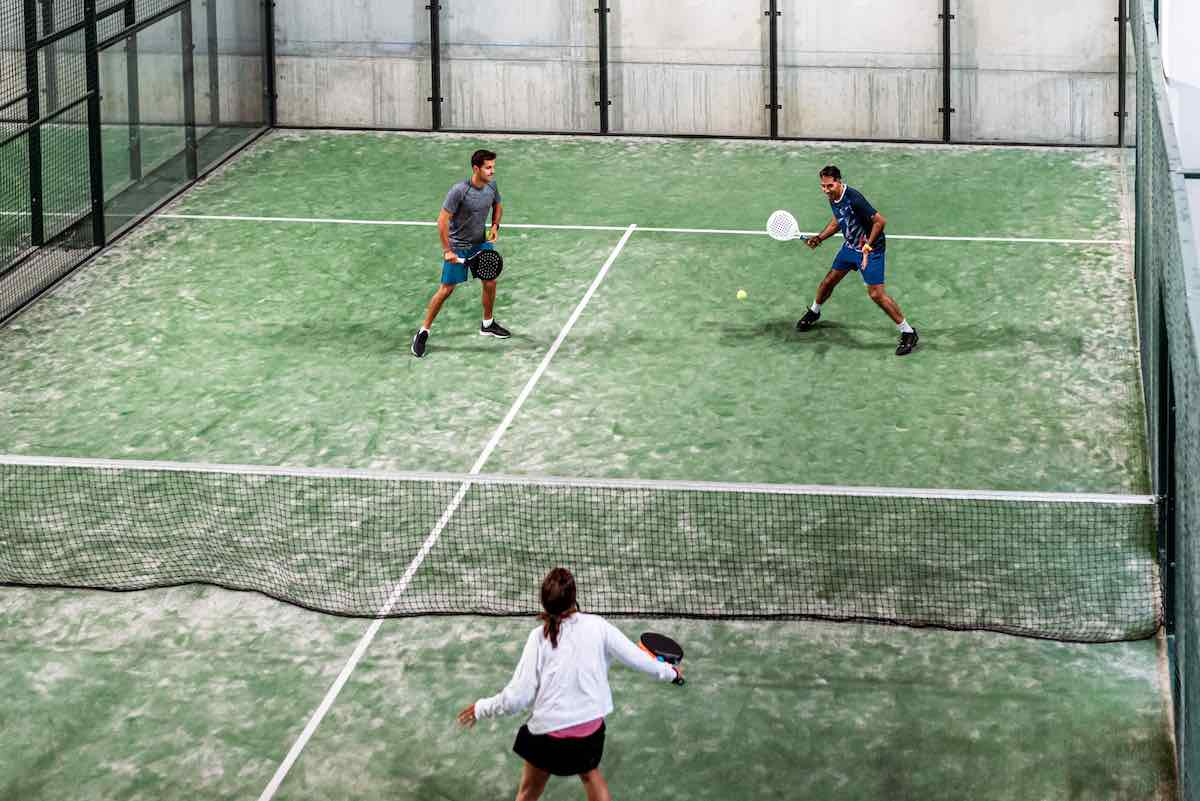
Positioning is the invisible skill that separates club players who win from club players who struggle — and the good news is it’s entirely learnable. You don’t need a better forehand or a harder smash. You need to understand where to stand, why to stand there, and how to move with your partner as a unit. Master that, and everything else in your game gets easier.
The Two Core Positions in Padel
Before you dig into tactics, you need to understand the fundamental split that defines padel doubles: every pair has a drive player (back court) and a volley player (net). The drive player builds the point; the volley player finishes it. These aren’t rigid labels — positions shift constantly during a rally — but the distinction gives you a mental framework for every decision you make on court.
At the most basic level, there are two zones you and your partner should occupy:
- At the backcourt — roughly 6 feet from the back and side walls, behind the service line
- At the net — a step or two back from the net, aligned with the second fence post from the net
These two zones are what you’re always trying to get back to. Everything that happens in between — the transitions, the switches, the sprints — is in service of getting yourself or your partner into one of these two positions. If you want to learn padel basics from the ground up, understanding positioning is the single biggest lever you have.
The Drive Player’s Role
The drive player operates from the backcourt. This doesn’t mean they’re passive — far from it. The backcourt player is the architect of the point, the one who reads the ball off the glass, constructs the rally, and creates the opening for the net player to put it away.
Building the Point from the Back
Your primary job at the back is consistency and direction. Hit the ball deep, preferably cross-court, and keep your opponents on the defensive. Low, flat drives to their feet are more valuable than aggressive shots that pop up into their wheelhouse. Every ball you keep in play is a chance for your net partner to intercept and finish the point.
The lob is the most important shot in the drive player’s arsenal. A good lob resets the rally, forces opponents off the net, and buys you time to move up. Learn to disguise your lob — if opponents can read it coming, they’ll be in smash position before it lands. Good footwork is the foundation of hitting a clean lob under pressure.
The Chiquita and Wall Shots
The chiquita — a low, short ball played cross-court — is the drive player’s attacking weapon when the net player is pushing up. It dips below net height and forces the opponent to play upward, creating a weak ball for your partner to volley. Mastering the chiquita turns you from a passive baseline player into a genuine threat.
Wall shots are the unique skill of the padel backcourt. Reading how the ball comes off the back glass — factoring in speed, spin, height, and angle — is what takes months to develop. Stand too close and the ball will jam you. Stand too far and you’ll be stretching. The standard reference point is 6 feet from the wall, adjusted based on pace and spin.
When to Push Up to Net
The drive player isn’t stuck at the back forever. The signal to push up is a good lob or a deep ball that forces opponents behind their baseline. As soon as your lob clears them, move forward with your net partner. Don’t wait for confirmation — commit to the advance and get into net position before the ball comes back. Hesitating in the middle of the court puts you in no man’s land, which is the one place you never want to be.
The Volley Player’s Role
The net player is the finisher. Their job is to be in a position to intercept, put balls away, and take time away from opponents. A great net player makes the drive player’s job dramatically easier — opponents are forced to aim for smaller windows and play defensively just to avoid the poach.
Court Position at the Net
Stand aligned with the second post of the fence from the net. This is far enough back to cover the lob but close enough to play aggressive volleys. Standing right up against the net is a classic beginner mistake — it leaves you completely exposed to a lob that lands behind you.
Your ready position matters: slight forward lean, racket up, weight on your toes. You want to be able to move in any direction instantly. A good net player is always slightly uncomfortable — always on the edge of motion.
Poaching and Closing Angles
Poaching — crossing to intercept a ball aimed at your partner — is one of the highest-percentage plays in padel. If you see the opponent winding up for a cross-court ball and you’re already reading it, step across and cut the angle. The key is committing: a half-hearted poach that you then pull out of leaves your side of the court wide open. Trust your read and go.
At the net, always be closing angles. Move toward where the ball is likely to come, not toward where you wish it would go. When opponents are deep and under pressure, move in tighter to the net. When they have time, give yourself more room to cover the lob.
When to Drop Back
The net player has to retreat when: a lob clears them, they’re out of position, or a smash is coming that they can’t reach. The cue to drop back is seeing the opponent’s racket go back for a high ball. Drop back early, in sync with your partner, and reassemble your defensive position. A well-executed kick smash from opponents can be almost impossible to handle if you’re caught flat-footed at the net.
Left Side vs Right Side
Conventional padel wisdom says: the stronger backhand plays the left, the stronger forehand plays the right. The logic is that the center — the most contested zone in any rally — is covered by the player with the more reliable shot from that side. The right-side player’s forehand can dominate the center; the left-side player needs a solid backhand to cover it.
Why Right Side vs Left Side Actually Matters
On the right side, most balls that come through the center are on your forehand. You’ll handle serve returns, cross-court volleys, and central exchanges from your forehand side — usually your most reliable weapon. The right side player often initiates net play off the serve, so having a confident forehand volley is important.
The left side is traditionally considered the more tactically complex side. You’ll deal with more backhand volleys, and the angles from the left corner — especially the cross-court through the center — require a trustworthy backhand. Advanced players often consider the left side the “engine room” of the pair’s defense.
The Beginner Reality
For recreational players and beginners, the left-right distinction matters less than people think. What matters more is playing on whichever side you feel comfortable and confident. If you’re a new player who happens to have a stronger backhand, the left side might suit you well. If not, start on the right. You can always swap as you develop. The most important thing is moving together with your partner — not which specific side you’re on.
Switching Positions
Switching sides during a rally is a legitimate tactic, but it requires precise communication and execution. Done wrong, it opens the biggest gaps imaginable. Done right, it can completely disrupt opponents’ patterns and create point-winning opportunities.
When to Switch
The most common scenario for switching is when one player is pulled wide to the corner and the other covers center by crossing. As the cornered player plays their shot and the partner crosses to cover, they’ve effectively swapped sides. This is natural — it happens in almost every rally at some point. The key is that both players know it’s happening and commit.
Another common switch is after a lob — one player retreats to play the ball and the other moves accordingly to maintain parallel positioning. The rule always holds: move together, or not at all.
The “X” Switch Pattern
The deliberate “X” switch is an advanced play where both players cross simultaneously — typically used to confuse opponents and change which player is controlling the center. It works best when your pair has a clear verbal signal (“switch!”) and the timing is practiced. If one player crosses and the other doesn’t, you’ve just opened a massive diagonal gap. Drill this in practice before trying it in a match situation.
Communication is Everything
Talk constantly. “Mine,” “yours,” “switch,” “back,” “up” — short, clear calls before or during the play. In the absence of communication, both players hesitate. Hesitation in padel means the ball lands between you. Loud, confident communication covers over tactical mistakes; silence amplifies them.
Common Positioning Mistakes
Even experienced players fall into recurring positioning errors. Here are the ones to watch for and actively eliminate from your game:
- Both players going back. When your lob is mediocre and you both retreat, opponents have a free pass to the net with two defenders out of position. One player always tries to hold the net if possible.
- Both rushing the net. If the partner at back hasn’t hit a quality lob or forcing ball, both rushing to net means a lob will land behind you with nobody to cover it.
- Diagonal gaps. The classic mistake — one player pressed back and the other camped at net. The open diagonal behind the net player and in front of the back player is the most exploitable space in padel.
- Standing too close to the net. You look aggressive, but you’re actually vulnerable. A floated lob above your head that you can’t recover is a free point for the opposition.
- Not lobbing enough from the back. Many club players try to win rallies with drives from the back rather than using the lob to reset and come to net. The lob is the backcourt player’s most important tool.
- No man’s land hesitation. Transitioning through the mid-court area and then stopping there. Always commit — either go to net or go back. Don’t hover in the middle.
Positioning for Different Game Situations
Serving
After serving, move forward immediately. You shouldn’t be waiting at the baseline to see if your serve lands in — by the time the return comes back, you want to be approaching the service line or beyond. Your net partner should be in their ready stance at the second post, already reading where the return is going.
Returning
The returning pair typically starts from the backcourt. After the return, the returner pushes forward if the ball was quality — a deep cross-court return gives you license to advance. A defensive return means staying back. The non-returning partner should be positioned at the back, ready to move up in sync when the returner does.
Defending a Smash
When opponents have a smash, both defenders go back and wide — taking position near the corners to give yourself room to read the ball off the glass. Don’t crowd the center. Give yourself space, keep low, and be ready for the wall rebound. A good defensive position after a smash often sets up a quality lob that wins back the net. Make sure you understand the padel rules on when a smash is a valid winner vs. a double bounce.
At Net vs Mid-Court Opponents
When your opponents are stuck in no man’s land, be aggressive. Move toward them, cut off angles, and look to put balls at their feet. Mid-court opponents have the worst of both worlds — too far for clean volleys, too close to play good wall shots. Exploit this by closing in and playing tight, dipping balls through the center.
Padel Position Basics: Where to Stand on a Padel Court
There are two basic positions you should learn if you are a newbie in the padel court:
- At the backcourt
- At the net
These two basic positions are crucial in any padel game. You can exploit these to your advantage, especially if your opponents lack harmony with their movement.
These will also determine how you can maximize and cover the court. It also allows you to move effectively with your teammate and defend your side of the court.
Basic Court Position: At the back of the court
The first basic court position is at the back of the court. Specifically, when you are at the backcourt, your positioning is 6 feet away from the back and side walls.
To ensure such distance, you must stand behind the service line between the separation of the first and second panels of the back glass (assuming that the padel court has five glass panels)
You should also stand between the separation of the first and second panels of the side wall from the corner.
However, if your padel court does not have the same number of glass panels, you can take one step back from the service line and two side steps from the side wall.
Stay in that stance, especially if your opponents are coming towards the net and spam balls towards your courtside.
Strike balls that force your opponents to press their backs at the back wall. In this case, hitting a good high ball will give you the perfect opportunity to gain net position.
Basic Court Position: At the net
The second basic court position you should learn is at the net. Similarly, it’s ideal that you stand 6 feet away from the side panels.
To measure your distance with the net, you can consider using the posts of the side wall as markers. Count the posts beginning from the entrance of the game area.
Your ideal ready-to-volley stance should be aligned with the second post. Commonly, the third post is where the fence and glass are separated.
Such a distance would help you hit short volleys easily while also ensuring to cover the back side of the court.
One COMMON MISTAKE newbies make is standing too close to the net. This padel positioning is one you should avoid.
Being too close to the net would leave a huge gap at the backcourt that your opponents could easily access.
They can blow a high ball that would force you and your partner to sprint towards the back. It would also be difficult for you to return the ball in such an instance.
Remember:
It’s okay to go towards the net to hit the ball. But make sure to move back after your shot.
Moving as a Team
One thing you should ALWAYS remember when playing padel is keeping a synchronous movement with your teammate.
By saying so, you must ensure that you are standing at the same spot as your partner on the other side of your court.
Hence, you have to move alongside your partner, both forward and backward, most of the time.
Moving forwards and backwards as a team
The movement you do as a pair is critical to ensure good positioning in the padel court. When you and your partner move together, you will likely avoid a position that exposes weak points. Good footwork is the foundation of all of this, so it’s worth practising your movement off the ball as much as your shots.
Try to picture two players: One is standing near the net while the other is pressed at the back wall. You’ll see a huge diagonal gap behind the front player and in front of the back player.
Such a gap is a CRITICAL WEAK POINT that would allow your opponents to strike a cross-court block volley. At this point, you’ll struggle to defend and return the ball.
Hence, moving forward as a team as you gain net position will help you avoid that weak diagonal point.
Moving side to side as a pair
Another movement you should do as a pair is moving from side to side. Doing so helps you avoid leaving a huge gap at the center field.
Moving side to side together is especially helpful when you or your partner are pressed towards the corner of the back wall.

As you move towards the corner, a wide space is left at the center of the court. Hence, your partner will need to go towards the center line to fill in and cover the middle.
However, your partner CANNOT move across the center. It will expose their side of the court, and your opponent can strike the ball on that side of the padel court.
Drive Player vs Volley Player: Comparison
Here’s a quick-reference breakdown of what distinguishes these two roles on court:
| Drive Player (Back) | Volley Player (Net) | |
|---|---|---|
| Primary zone | Behind service line, 6ft from walls | Near net, aligned with second post |
| Key shots | Lob, chiquita, drive, wall shots | Punch volley, put-away volley, poach |
| Defensive responsibility | Wall rebounds, deep lobs, corner balls | Balls through center, tight cross-courts |
| When to move up | After a quality lob or deep forcing ball | When opponent is under pressure behind baseline |
| When to drop back | Rarely — hold position and build | When lob clears, when smash incoming |
| Common mistakes | Not lobbing enough, going to no man’s land | Standing too close to net, failing to poach |
Positions While Defending
The right padel positioning is also vital when you are in a defensive position. One thing you should always note when defending is CONSISTENCY.
Being consistent with your padel positioning at defense will help you defend and return a lot more balls than you expect.
While a defensive position is vital in every game, what frustrates many players is positioning at the back wall and the corner.
How to position for a bounce against the back wall?
There are five factors that would determine if the ball would bounce against the back wall:
Speed
When a ball moves fast, it’s more likely to move your feet forward. Hence, there’s a high chance that it would hit the back wall. In this case, you must move forward.
Spin
A slice would cause a ball to go at a lower angle. Therefore, you should also station yourself lower and closer to the wall.
But, if you can see a ball approaching with a topspin, you must move your feet towards the right as it may also hit the glass panel.
Angle
If the ball blew off from a harsh angle, move away from the ball. There’s a high chance that the ball will fly out towards you.
Height
You must move forward when you gauge the ball likely hitting a higher part of the back glass. Contrarily, if the ball is going to hit at a lower angle, move your feet closer.
Temperature
Hotter balls bounce more than cool balls. Hence, you must position yourself far forward. But, you must be lower and closer to the glass in cold weather.
Padel positioning when defending the corner
The five factors discussed above are likely to be the same ones you must deal with when judging incoming balls and determining your padel positioning.
But, there are two additional tips we can teach you when defending balls that hit the side glass first:
Turn and Play
You can opt to make a 360-degree turn before you play the ball. However, you have to be quick to follow the ball’s direction.
This requires a more natural movement that can’t be taught in one coaching session. But, mastering this technique would help you hit the ball easier.
Move away
A simpler option is moving your body away from the ball before blowing it off. This allows you to see the opposing team’s movement from the other half of the court.
However, it’s also difficult to judge the ball’s trajectory at this angle. When doing this technique, always remember to move early.
Avoiding No Man’s Land
Ideally, the player must stand behind the white line or service line for a backcourt position or a few steps back from the net for the net position.
However, the area between these two ideal positions is the area you should avoid: no man’s land.
The term already explains itself. No padel player wants to land on that spot because it’s where they make fewer points.
- It’s a position too far back to volley the ball
- It’s a spot too far forward to hit the ball after the wall
- It’s difficult to defend the ball directed towards the back, unlike in the backcourt position
- It’s not an ideal position to play advanced and difficult balls, unlike in the net position
There would be instances where you have to move towards this area to hit the ball. But, always ensure to GO BACK to the right place.
Improving Your Court Positioning
Reading about positioning is a start, but the real gains come from deliberate practice and match observation. Here’s how to accelerate your development:
Drills to Build Positional Awareness
Shadow movement drill: Without a ball, practice advancing to net together with your partner after a simulated lob, then retreating together when you call “smash.” Do this until the synchronous movement is automatic. Ten minutes of shadow movement before a session is worth more than most people realize.
Lob and advance: One pair at net, the other pair at back. The back pair must hit a quality lob before they’re allowed to advance. Net pair plays the smash and defends. The constraint forces the back pair to develop their lob and recognize the correct moment to push up.
No man’s land penalty game: Play points where any player caught in the mid-court zone when the ball is hit loses the point automatically (honor system). This sounds harsh, but it rewires the instinct to hover very quickly.
Watch Professional Matches
Watching Premier Padel or World Padel Tour matches specifically for positioning — not for the spectacular shots — is one of the best self-coaching tools available. Mute the commentary if it helps you focus. Watch where the players are standing before each shot, not just how they hit it. Notice how the net player reads the cross-court cue and starts their move. Notice how the back player instantly reads their partner’s lob quality and commits to advancing. This is high-level education for free.
The US padel scene is growing fast, so if you’re competing in tournaments, watch footage of your local circuit too. Check out the US padel hub for resources on finding courts and clubs near you, or look at the US tournament guide if you’re ready to compete.
Communication Habits to Build With Your Partner
Commit to calling “mine” or “yours” on every ball for an entire session, even when it’s obvious. It feels silly at first and becomes invaluable under pressure. Also agree on specific words for the switch — “cross” or “swap” — and practice using them in low-stakes practice points before trusting the call in a match. The goal is that by the time you’re in a tight third set at a club tournament, your positioning communication is automatic.
FAQ — Positions in Padel
The two core positions are the drive player (backcourt) and the volley player (net). The drive player builds the point from the back using lobs, drives, and wall shots. The volley player operates near the net to intercept and finish points. Both players shift between these roles during a rally, but always in sync.
Conventional wisdom places the stronger backhand on the left and the stronger forehand on the right, since the center of the court is contested most often. For beginners, the most important thing is playing on the side where you feel most comfortable and confident. You can always switch as you improve.
No man’s land is the mid-court area between the service line and the net position. It’s the worst place to be caught when the ball is hit because you’re too far back to volley effectively and too far forward to play off the wall cleanly. Always commit to either the backcourt or net position — never linger in between.
Switching happens naturally when one player is pulled to the corner and the other crosses to cover center. A deliberate switch (the X pattern) requires both players to cross simultaneously with a clear verbal signal. Communication is essential — call the switch before or during the movement, not after. Drill switches in practice before using them in matches.
The fastest fix is to focus on one thing per session: synchronous movement. Make a rule that you and your partner must always be at the same depth (both at net or both at back). Once that becomes automatic, you can add complexity — left-right coordination, switch patterns, poaching. Most positional errors come from one player advancing while the other stays back, opening the diagonal gap.

Lucas Sánchez is the founder of SimplePadel. Born and raised in Spain, Lucas has been living in the US and UK for the last 20 years and currently calls Miami his home. While he’s never played professionally, the dream is still alive.
Lucas loves nothing more than playing (and talking) about padel, and he considers himself lucky to have a wife and family that share his love for the game.
24 replies on “The Ultimate Guide to Positions in Padel”
[…] It aids the player in taking good advantage of the net position. […]
[…] The Ultimate Guide to Positions in Padel […]
[…] run through the fundamental positions, swinging force, Padel rules of the serve, and ways of ensuring that your service leaves your […]
[…] enjoy it, chances are that padel will also appeal to you. The foundation of the game is based on good positioning and strategy, using speed and accuracy to place the ball where it will put your opponent under […]
[…] opponent’s body to the wall or the ‘T’ on the opposite side of the track. The conditions and positioning of your opponents will determine how it is carried […]
[…] We’ll look at how to spin a ball coming to you without too much difficulty. We’ll see how the net position and ball speed affect which shot to […]
[…] a T-shirt and pants that are too tight can cause skin irritation. It may also hinder your movements, leading to injuries and bad […]
[…] to the frame of your racket can happen when you clash with your partner or hit the ground too low in an attempt to save the ball in […]
[…] Focus on your hand-eye coordination. Also, be mindful of your physical movement and position in the court. […]
[…] means that your shoes need to be able to handle more sideways movement, should help you bounce the balls off the wall, and should keep your knees […]
[…] The x-shaped patterns prevent your racket from sliding regardless of movement. […]
[…] Children can start playing kids Padel at a young age, even as toddlers. This is because sports like Padel allow them to develop their motor skills, give them the experience of overcoming challenges, and teach them teamwork as you have to move around the court as a pair. […]
[…] The Ultimate Guide to Positions in Padel […]
[…] The Ultimate Guide to Positions in Padel […]
[…] Adaptia System of the Bullpadel Hack 03 2022 allows the racket surface to become more rigid while defending quick balls. When you hit a ball hard, the ball comes out […]
[…] So, it is best for advanced and semi-professional players looking to add power. It also has the right balance of features to make this padel racket good for defending. […]
[…] The Ultimate Guide to Positions in Padel […]
[…] The Ultimate Guide to Positions in Padel […]
[…] For beginners and those new to racket sports, honing your footwork skills is a must to gain an edge over your competitors and excel to the next level. Great footwork goes hand in hand with great positioning on the court. […]
[…] must ensure you’re in a good position to play a kick […]
[…] The Ultimate Guide to Positions in Padel […]
[…] beginners will often need help with how to position themselves on the court, and one reason is that it can be a little bit tricky to do a backhand service return if you’re […]
[…] The Ultimate Guide to Positions in Padel […]
[…] Court awareness is vital in padel. Know where you are on the court at all times. Pay attention to your partner’s position too. […]