
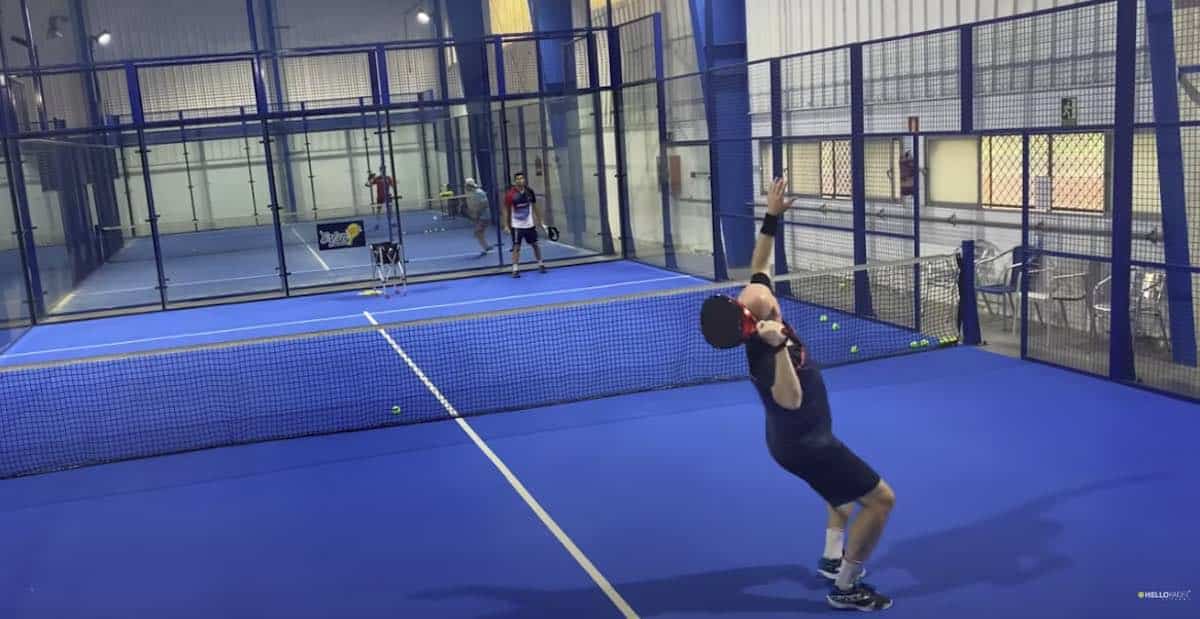
The kick smash is the most spectacular shot in padel — the only one that can definitively end a point even at the pro level. It’s also the most overhit shot at amateur level. Watch any club night anywhere and you’ll see beginners trying to murder lobs with flat smashes that bounce off the back glass straight back into their own chests. The kick smash is the answer to that. Done right, the ball clears the back glass entirely and rolls into the parking lot. Done wrong, you set yourself up for a counter that ends the point against you.
Most beginners get this shot wrong for one reason: they go for power instead of spin. They watch Galán launch a ball into row Z at Premier Padel Madrid and think the answer is a bigger swing. It isn’t. The kick smash is a topspin shot first and a power shot a distant second — the spin is what makes the ball bounce out of the cage, not the speed. If you’re new to padel itself and not just the kick smash, start with our guide to what is padel for the basics first.
This article is the un-watered-down version: how the shot actually works, when to use it, when not to, and the specific mistakes I see at every US club I’ve played at. No “comprehensive guide” filler.
Padel smash types compared: which one to actually learn
Before we go deep on the kick smash, here’s the honest hierarchy of overhead shots in padel. If you’re under a year in, ignore the bottom two rows and come back later. There’s a fuller breakdown in our guide to the different shots of padel explained.
| Smash type | Difficulty | When to use | Beginner verdict |
|---|---|---|---|
| Flat smash | Easy | Short lob, you’re at the net | Use sparingly — ricochets back |
| Topspin smash | Medium | Mid-depth lob, want pace | Solid all-rounder |
| Bandeja | Medium | Defensive, maintain net position | Learn before kick smash |
| Vibora | Hard | Aggressive overhead, generate spin | After 1 year of play |
| Kick smash | Very hard | Deep lob, you have time | The reward shot — worth practising |
| Gancho | Very hard | Lob to your weak side | Pro-level — skip for now |
Kick smash technique: the six things that actually matter
One reality check before the technique notes: pro players hit kick smashes that fail more often than they succeed. Galán and Tapia at Premier Padel events still see 30-40% of their kick smashes returned. If pros miss this often, stop trying to land 100%. Aim for a 60% conversion at club level and you’re already winning a lot more points than your opponents.
1. Position — closer to the net than you think
The single biggest beginner mistake on the kick smash isn’t power or grip — it’s distance from the back glass. Stand 2 metres in from the net, not 4 metres in. The angle matters more than the swing. From 4 metres back you’re hitting almost flat into the opponent’s glass; from 2 metres in you’re hitting down at the angle that actually generates the bounce-out trajectory. Court positioning around this shot is covered more broadly in our guide to positions in padel.
Centre of the court is also non-negotiable. From the tramlines you don’t have the angle, period. If the lob pulls you wide, hit a bandeja and reset — don’t force the kick smash from a position that won’t reward you.
What I see at every US club:
Players park themselves 4-5 metres from the net waiting for the lob, then wonder why their smash bounces off the back glass and lands at their feet. The fix is boring and free: move forward two metres before the smash, not after. Spin matters, but geometry matters more.
2. Posture and load — the non-dominant arm tells the truth
Watch Lebrón set up a kick smash. The non-dominant arm goes up early, points at the ball, and stays up until the moment of contact. That isn’t a stylistic flourish — it’s what keeps your shoulders rotated and your chest open. Drop the off-arm and your trunk collapses and you flatten the swing.
Lean back into the load, then transfer through. Feet quiet on the load, weight shifting forward through contact. If your back foot is moving while you swing, you’re hitting off balance and the spin axis goes with it.
3. Grip — Continental, loose wrist, snap on contact
Continental (handshake) grip. Not eastern, not semi-western. Tennis players who carry over their forehand grip end up flat-smashing every time and can’t generate the brush — Coello and Chingotto don’t grip the racket like a tennis forehand for a reason.
Wrist loose on the take-back, snap at contact. The snap is what brushes up the back of the ball and creates the topspin. A locked wrist hits flat 100% of the time.
Reminder:
If your elbow hurts after a session of smashes, the grip is too small or the wrist is too tight. An overgrip fixes the first; a few sessions of conscious wrist relaxation drills fix the second.
Racket choice for the kick smash
Hot take: the racket matters less than YouTube comments suggest. A tournament-level player will hit a perfect kick smash with a $100 round racket. A beginner will fail the shot with a Bullpadel Vertex 04. That said, the right tool helps — diamond-shaped rackets put the sweet spot high in the head, which is where you contact the ball on a kick smash. For under a year of play, stick with a hybrid or round shape and start with our list of best padel rackets for beginners.
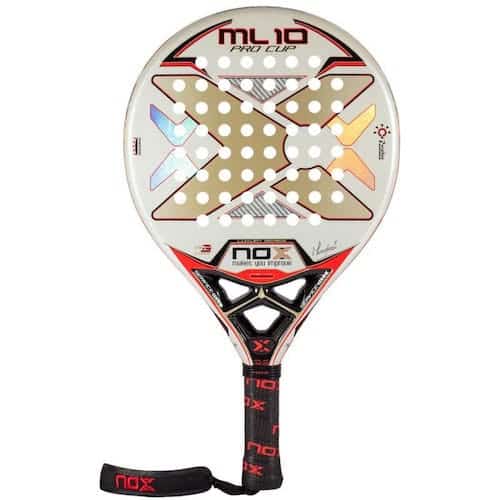
- New SmartStrap™ replaceable safety strap system
- The AVS lateral anti-vibration system helps facilitate shots and achieve a great spin
- Lamperti’s signature racket — built around the kick smash and vibora
4. Contact point — slightly forward, slightly above
Ball contacts the strings just above your head and slightly in front of your body. Not behind, not directly overhead. Behind = flat shot into the back glass that comes back at you. Directly overhead = no forward momentum into the spin. Slightly in front gives the racket head room to brush up and through.
If you’re coming from tennis, this contact point is roughly the same as a kick serve, not a flat overhead. Same brushing motion, same upward racket path through the ball.
Tip:
Tennis players: kill the flat overhead muscle memory. The kick smash isn’t a put-away. Treat it like a kick serve aimed at the opponent’s back glass.
5. Aim — service line, opponent’s deuce side
Aim the bounce on or just before the opponent’s service line. Too short and the ball doesn’t have the angle to climb the glass; too deep and it bounces low off the back glass and your opponent runs around to play it before it dies. The deuce-side service-line area is the sweet spot at club level — most amateurs are weaker on that wing.
Typical kick smash exit speed at club level is 60-90 km/h with heavy topspin. Pros hit 90-110 km/h. Don’t try to outhit Tapia. The spin is what wins the point.
6. Timing — patience, then commit
Hit the ball at the apex of its drop, not on the way up. Most amateurs swing too early because they’re nervous. Let the ball come down to the contact zone, then commit fully. Half-committed kick smashes are the worst possible shot — slow enough to be returned, flat enough not to bounce out.
If you’re rushing into smashes, you’re not warmed up. Run through the overheads in our padel warm-up guide before any session you plan to attack from the net.
Defending against the kick smash
If the smash is incoming and the ball is heading deep, don’t try to volley it. Step back, let it hit the back glass, and read the bounce. Step toward the side glass as the ball rebounds and run toward the net once you’ve struck it — net position is everything in the rally that follows.
Against weaker amateur smashes (the ones that don’t actually clear the cage), the easiest counter is the “para tres” — let the ball bounce twice off the glasses and lift it softly back. Most club-level kick smashes don’t have enough true topspin to stop you from doing this. Watch how Navarro defends from deep at WPT events and copy that footwork.
The other smashes worth knowing
The kick smash isn’t the only overhead in your bag. Each of these has a job and using the right one is half the battle.
1. Gancho
A side-spin overhead aimed cross-court. Pro-level shot — Chingotto and Tello hit gorgeous ganchos to the deuce-side glass. At amateur level, skip it for the first year. The motion is between a smash and a bandeja and the margin for error is brutal.
Warning:
Force the gancho before you’ve grooved the kick smash and you’ll feed your opponent easy mid-court rebounds for the rest of the match.
2. Topspin smash
The kick smash’s less-aggressive cousin. Topspin to keep the ball in court rather than to fly it out. Use this when the lob isn’t deep enough for a true kick smash but you still want pace. This is the workhorse overhead — most pros hit far more topspin smashes than kick smashes in a given match.
3. Kick smash
Heavy topspin overhead aimed to bounce off the back glass and clear the cage. The shot this article is about. Reward shot — earn it with the right setup, don’t force it from a poor position.
4. Flat smash
No spin, all power. Use only on short lobs you can take above the net line — closer to a tennis put-away. From deeper in the court the flat smash is a gift to your opponent: it ricochets predictably and they’re already at the net waiting.
Bottom Line
The kick smash is a spin shot before it’s a power shot. Stop trying to hit it harder and start trying to hit it with more topspin from two metres further forward. That single change wins more points than any racket upgrade ever will.
Stack the prerequisites: bandeja first, topspin smash second, kick smash third. Skipping straight to the kick smash because it’s the cool shot is why most amateurs spend a year hitting it badly. Earn the shot.
And if your conversion rate is 60% at club level, you’re already ahead of the field. Even Galán and Tapia miss this shot four times out of ten — chase consistency over perfection and the points stack up.
Frequently Asked Questions about the kick smash in padel
To hit a topspin smash in padel, start with a continental grip and position yourself below the ball. As you swing, accelerate your racket upwards and brush the back of the ball with an upward motion. The brush will help the ball exit the court on either side, depending on your aim.
To execute a topspin smash, use a continental grip, and prepare your racket behind and above your head. As you swing forward, snap your wrist and brush the back of the ball in an upward motion to generate topspin. Finish the follow-through with your racket pointing towards the ground.
It depends on the type of smash, but generally; aim your smash at the weak spots of your opponents’ court, such as the corners or near the walls. Target areas where your opponents have difficulty reaching or returning the ball. Remember to mix up your shots to keep your opponents guessing and prevent them from anticipating your next move.
To smash the ball out of court in padel, hit the ball with enough power and a slightly upward/side trajectory so that it bounces on the opponent’s side, in the glass, and then goes over the fence and out of court.
Top pro players can hit kick smashes at 90-110 km/h (55-68 mph) with heavy topspin. The spin matters more than the speed — a 90 km/h kick smash with heavy topspin will bounce out of court more reliably than a 110 km/h flat smash.
Use a regular flat smash when the lob is short and you can comfortably reach it at the net. Use a kick smash when the lob is deep, you have time to get under it, and you’re closer to the centre of the court. The kick smash needs the angle, depth, and topspin that only deep lobs allow.

Patricia Nguyen is a former pickleball player who joined SimplePadel as a Content Writer in late 2022. She lives in Texas with her two dogs and is an avid fan of the sport. Her favorite player is Ale Galán, whom she believes to be the best defensive padel player that ever played the game.