
Padel vs racquetball: they are not the same sport, although both are played inside walls. Padel is a doubles game over a net on a 20 x 10 m court with a solid, stringless racket and a pressurized ball, and the walls are used after the ball bounces. Racquetball is a no-net game in a sealed 40 x 20 x 20 ft box with a strung racquet and a fast hollow rubber ball, and the ceiling is live. Racquetball players often find padel’s walls familiar and its pace friendlier.
This guide compares the courts, equipment, serve and scoring, and explains what carries over if you are switching. For other comparisons, see padel vs squash, padel vs paddleball and padel vs pickleball.
Thinking of trying padel? A racket and a tube of balls is all you need. See our picks for the best padel rackets for beginners, or start with a value pick such as the Wilson Carbon Force Team.
Padel vs Racquetball: At a Glance
| Feature | Padel | Racquetball |
|---|---|---|
| Court | 20 x 10 m (about 66 x 33 ft) with a net | 20 x 40 ft, 20 ft high, no net |
| Walls and ceiling | Walls up to 4 m, no live ceiling | Front, side and back walls plus the ceiling |
| Bat | Stringless perforated racket, up to 45.5 cm long | Strung racquet, up to 22 in long |
| Ball | Felt-covered pressurized rubber, 56.0 to 59.4 g | Hollow rubber, about 1.4 oz (about 40 g), about 2 1/4 in |
| Bounce test | 135 to 145 cm from 2.54 m, about 53 to 57% | 68 to 72 in from 100 in, about 68 to 72% |
| Serve | Underhand after a bounce, at or below the waist, two attempts | Drop serve: drop the ball and hit it after one bounce |
| Scoring | Tennis points, often with the golden point | Side-out: only the serving side scores, games to 15 |
| Players | Almost always four | Two or four |
| Eye protection | Recommended | Required in sanctioned events |
The bounce percentages are our calculation from each sport’s drop-test specification.
The court and the walls
A padel court is about 2.7 times as large as a racquetball court, roughly 2,150 square feet against 800. It is split by a net and enclosed by glass or solid walls with mesh above them, and there is no live ceiling. Racquetball has no net at all. Players take turns hitting a front-wall target inside a sealed box, and the ceiling, floor and every wall are in play.
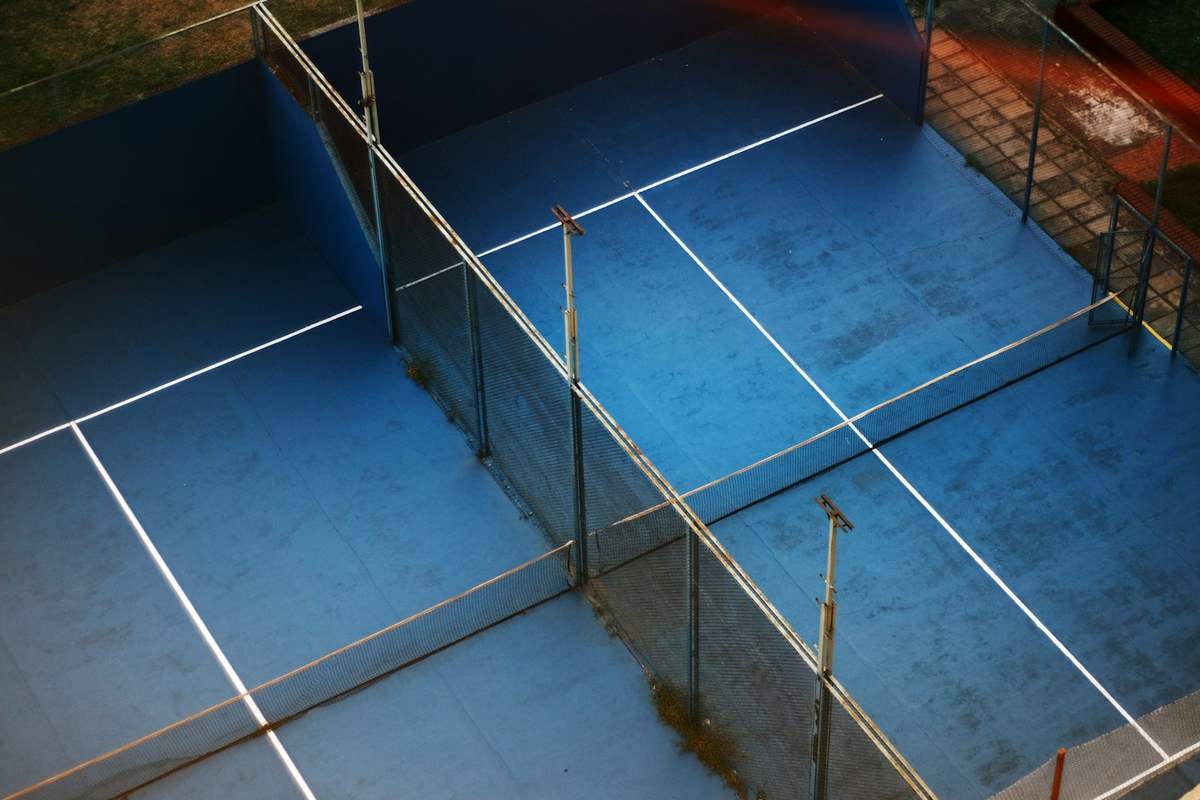
Both games are wall games, but they use walls differently. In padel the ball has to bounce on the court first, and the glass is a rebound, as our padel rules guide explains. In racquetball the ball goes to the front wall first, and the ceiling can be part of a shot.
Racket vs racquet
A padel racket is solid and perforated, with no strings, and it is capped at 45.5 cm overall and 38 mm thick. A racquetball racquet is strung and can be up to 22 in long, so it is noticeably longer. That changes the technique: padel is played with short, compact swings, and the power comes from the racket’s mass and the shot rather than from string tension. Our guide to padel racket types and shapes covers what to look for.
The ball
A racquetball is a small, hollow rubber ball, about 2 1/4 in across and about 1.4 oz, that rebounds around 68 to 72 percent of its drop height. A padel ball is larger and heavier, at 6.35 to 6.77 cm and 56.0 to 59.4 g, and it rebounds around 53 to 57 percent. That is why racquetball is a faster, sharper game, and why padel rallies last longer. Our guide to padel balls vs tennis balls explains how the padel ball is built.
Serve and scoring
In padel the serve is underhand, follows a bounce, is struck at or below waist height and goes diagonally over the net, and a missed first serve earns a second attempt. Our padel serve rules guide covers it in detail. In racquetball you drop the ball in the service zone and hit it after one bounce.
Scoring is different too. Padel counts points in tennis style, 15, 30, 40, often with the golden point at deuce. Racquetball uses side-out scoring: only the serving side can score, games go to 15 points, and a tiebreak game to 11 settles a match that is one game each.
Singles or doubles?
Racquetball is played by two players or four. Padel is almost always doubles, which changes the feel of the game: you share a small court with a partner, so communication and positioning matter as much as the shot itself. Our guide to positions in padel covers where to stand, and which side to play helps you pick your place on court.
If you play racquetball, will padel click?
Racquetball players often adapt quickly to reading rebounds and to reacting in a small space. The biggest changes are the net, the lack of a live ceiling, the solid racket and the slower ball. Because padel is a doubles game, most of the learning curve is positioning and teamwork rather than hitting.
- Learn the basics of the game first, which our beginner guide to how to play padel covers
- Use our guide to positions in padel to see where the two players stand
- Read our guide to the different shots of padel and start with a simple lob and volley
- Book a first lesson or an open-play session at a club. Our directory records lessons at 161 of the 358 US clubs we list
Eye protection
Racquetball requires lensed eye protection at sanctioned events and penalizes players without it. Padel’s rules do not require it, but the ball travels in a small enclosed space, so eye protection is a good habit. Racquetball goggles are a good option, and our padel glasses guide explains what to look for and includes racquetball and squash goggles among its picks.
Which should you play?
If you want a sociable, doubles-based game with longer rallies and an easy serve, choose padel. If you like fast, solo-friendly wall play, racquetball is a great sport, and you can play both. To find courts near you, see our padel in the US guide.
The bottom line
Padel and racquetball share walls, but not much else. Padel has a net, a solid racket and a slower ball, and it is played in pairs, while racquetball is a sealed-box game with a strung racquet and a fast hollow ball. If you are already comfortable with walls, padel is an easy sport to add. Start with our complete guide to what padel is.
Frequently asked questions about padel vs racquetball
No. Padel is played over a net on a 20 x 10 m court with a solid racket and a pressurized ball, and it is almost always doubles. Racquetball is played in a sealed box with no net, a strung racquet and a hollow rubber ball.
No. A padel court has no live ceiling, and a ball that hits the roof, the lights or another object off the court is out. Racquetball has a live ceiling.
No. The padel rules describe a solid racket with a perforated hitting surface, so a strung racquetball racquet is not legal, and it would not play the same way in any case.
Not sensibly. A racquetball is smaller, lighter and livelier than a padel ball, so it behaves differently off the walls and would make padel hard to control.
A racquetball court is 20 x 40 ft, or 800 square feet. A padel court is 20 x 10 m, roughly 2,150 square feet, so it is about 2.7 times as large.
Padel uses tennis points, 15, 30 and 40, often with a golden point at deuce. Racquetball uses side-out scoring, where only the serving side scores, and games go to 15.
Racquetball requires lensed eye protection at sanctioned events. Padel does not require it in the rules, but it is strongly recommended in a small enclosed court.
Many beginners find padel easier to start because the ball is slower, the serve is underhand and the games are played in pairs. Neither is easy to master, and racquetball players usually adapt to padel quickly.

Isabella Torres is originally from Madrid, Spain, and has been playing Padel as a semi-professional for the past five years. After completing her education as a journalist, she discovered her true passion in life was writing about Padel.
She loves staying up late watching intense rallies on YouTube, and is excited to share her knowledge about the sport with SimplePadel’s readers.