
No, padel and paddleball are not the same sport. Padel is played on an enclosed glass court where the walls are part of every rally, with a stringless perforated racket and a tennis-like ball. Paddleball is an American racket sport played against a single handball-style wall (or inside a four-wall court), using a small solid paddle and a hollow rubber ball, where only the server can score. They share the word “paddle,” but that is close to where the resemblance ends.
Paddleball is also easy to confuse with paddle tennis (pop tennis), a completely different sport that borrows tennis scoring and is played on an open mini-tennis court. This guide is specifically about paddleball, the wall-based, handball-style game — not paddle tennis. If it is padel vs. other racket sports you are after, see our padel vs pickleball, padel vs squash and padel vs tennis comparisons.
Thinking of trying padel instead? All you need to start is a racket and a tube of balls. See our picks for the best padel rackets for beginners and the best padel balls — or grab a forgiving round-shape pick like the Babolat Contact.
Padel vs Paddleball: At a Glance
| Feature | Padel | Paddleball |
|---|---|---|
| Court | 66 x 33 ft, enclosed by glass & mesh walls | 20 x 34 ft (one-wall) or 20 x 40 ft (four-wall) |
| Walls in play? | Yes — central to the game | Yes — the wall(s) are what you hit against |
| Equipment | Stringless, perforated solid racket | Small solid paddle (max 17.25in), no strings |
| Ball | Tennis-like, low pressure | Small, hollow rubber ball |
| Serve | Underhand, bounce first, over a net | Underhand off the wall, no net at all |
| Scoring | Tennis scoring (15/30/40) | Only the server scores; games to 21 (win by 2) |
| Format | Almost always doubles | Singles or doubles |
| Learning curve | Easy to start, walls take time | Easy to start, side-out scoring takes a game to click |
Are Padel and Paddleball the Same?
No. They are different sports with different courts, equipment, balls, and scoring systems. The confusion is understandable — both names come from the same root word, both use a solid, stringless paddle, and both let you play the ball off a wall. But padel is played over a net on a fully-enclosed court sized like a shrunken tennis court, with tennis-style scoring. Paddleball has no net at all: you serve the ball directly against a front wall, and only the server can add to the score, much like racquetball or American handball. If you can play one, the other will feel genuinely unfamiliar rather than a variation on a theme.
What Is Padel?
Padel is a doubles racket sport played on an enclosed court about a third the size of a tennis court, surrounded by glass and mesh walls that are part of play. You serve underhand, score it like tennis, and rallies run long because the walls keep the ball alive. It is the fastest-growing racket sport in the world. For the full rundown, see our guide to what padel is and how to play padel.
What Is Paddleball?
Paddleball is an American racket sport played against a wall with a small, solid, perforated paddle and a hollow rubber ball. There is no net: you serve the ball onto the front wall and it must come back past a service line before the returner plays it, similar to racquetball or handball. Two versions exist — one-wall paddleball, played outdoors against a single tall wall (common in New York City parks), and four-wall paddleball, played inside a fully-enclosed racquetball-style court. Only the serving side can score a point, and games are usually played to 21.
Where Padel and Paddleball Came From
Padel was invented in 1969 in Acapulco, Mexico, by Enrique Corcuera, who walled in a small court at his home and adapted tennis to the space. It spread to Spain and Argentina in the 1970s, became a mainstream sport across the Spanish-speaking world, and has since exploded globally as one of the fastest-growing sports on the planet.
Paddleball has two separate American origin stories. One-wall paddleball grew out of handball in New York City in the early 20th century, when players started using wooden paddles instead of bare hands against the same public handball walls found in parks across the city. Four-wall paddleball was invented in 1930 by Earl Riskey, a physical education instructor at the University of Michigan, who adapted the game to fit inside the school’s indoor handball courts. Both versions stayed a niche, mostly regional American pastime, overseen today by the National Paddleball Association (NPA) — nowhere near the global scale padel has reached.
The Court: Enclosed Glass vs a Single Wall
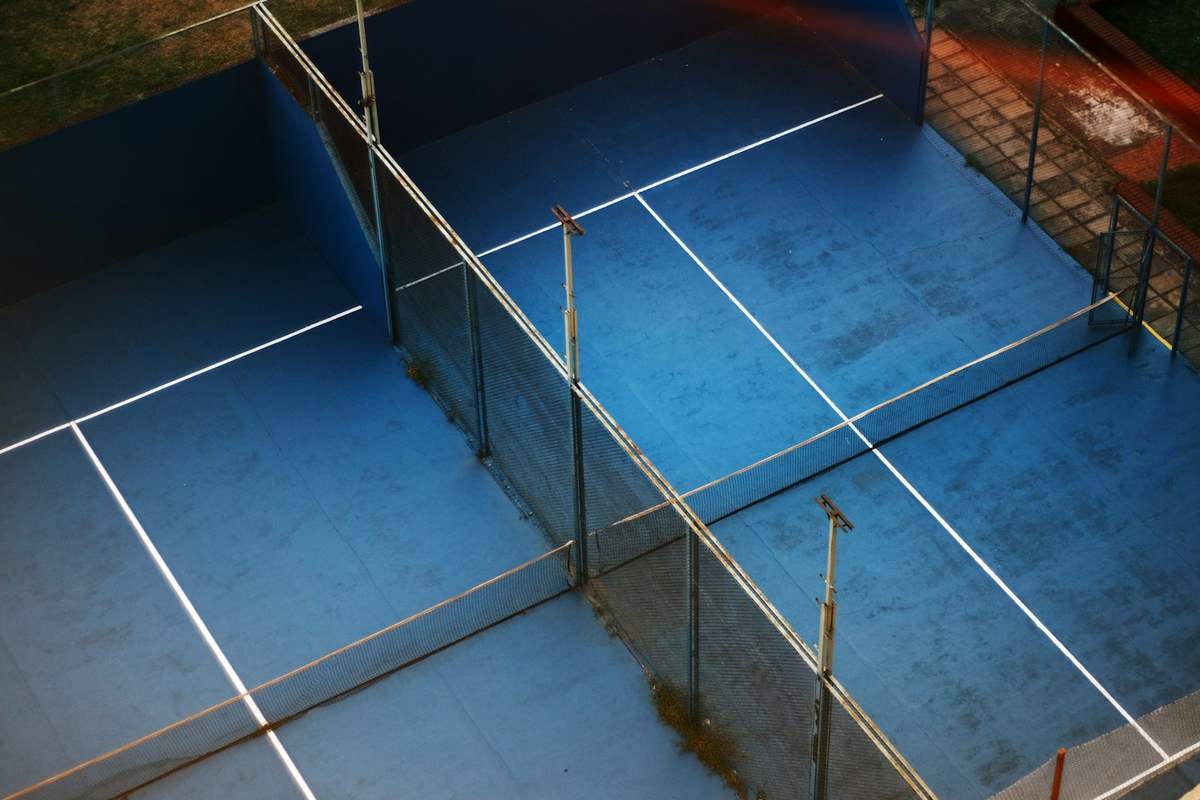
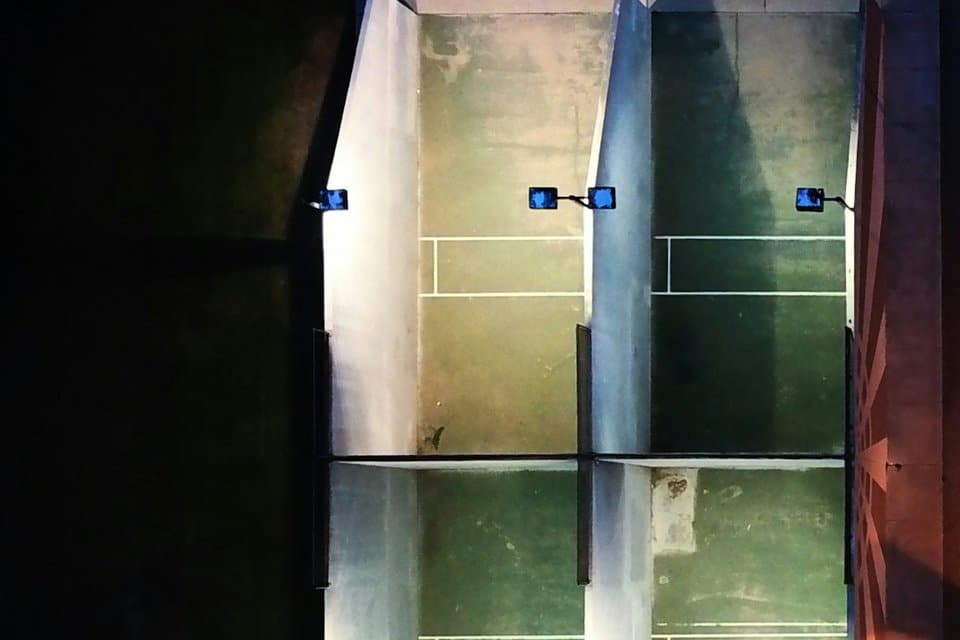
This is the biggest structural difference. A padel court is 66 x 33 ft, fully enclosed by glass and mesh walls on all sides, split by a net in the middle like tennis — you hit the ball over the net, and the walls only come into play after it bounces. A one-wall paddleball court is just that: a single 16-ft wall with a painted floor 20 ft wide and 34 ft long, completely open on every other side, with no net anywhere. Four-wall paddleball swaps the single wall for a fully enclosed 20 x 40 ft box, borrowed directly from racquetball. Either way, there is nothing in paddleball resembling padel’s glass-and-net setup.
Equipment: Racket vs Paddle
Both sports use a solid, stringless hitting surface, but the similarity mostly ends there. A padel racket is thick, foam or EVA-cored, wrapped in carbon or fibreglass, perforated with holes, and has a wrist strap; padel rackets weigh around 360 to 385g. A paddleball paddle is much smaller and lighter — official rules cap it at 17.25 inches long, 8.5 inches wide, 0.75 inches thick and 16 ounces, built from wood (often 7-ply ash) or a composite like graphite, with a mandatory safety strap. The balls differ just as much: padel uses a depressurised tennis-style ball, while paddleball uses a small, hollow rubber ball built to survive being hit hard against a wall repeatedly. If you are starting padel, our best beginner padel rackets guide covers the forgiving, round-shape options.
Court and Equipment Specs Compared
If you prefer the numbers side by side, here is how the two sports stack up. First the courts:
| Court spec | Padel | Paddleball |
|---|---|---|
| Dimensions | 66 x 33 ft (20 x 10 m) | 20 x 34 ft (one-wall) / 20 x 40 ft (four-wall) |
| Area | ~2,178 sq ft | ~680 sq ft (one-wall) / ~800 sq ft (four-wall) |
| Enclosure | Glass + mesh walls on all sides (in play) | One wall (one-wall) or four walls (four-wall) |
| Net | Yes, ~88 cm centre | None |
| Typical setting | Dedicated padel clubs | Public parks (one-wall) or gyms/rec centres (four-wall) |
And the equipment:
| Equipment | Padel | Paddleball |
|---|---|---|
| Implement | Stringless solid racket | Small solid paddle, no strings |
| Max size | No official cap; ~45.5 x 26 cm face | 17.25in x 8.5in x 0.75in (NPA rules) |
| Weight | 360-385 g | Up to 16 oz (~454 g) |
| Material | Perforated foam/EVA core, carbon or fibreglass | Wood (e.g. 7-ply ash) or composite |
| Strap | Yes (wrist safety cord) | Yes (mandatory safety strap) |
| Ball | Tennis-like, ~10-11 PSI | Small, hollow rubber ball |
The Ball: Padel Ball vs Paddleball
A padel ball looks and feels like a tennis ball; a paddleball is a small, hollow rubber ball built for wall play. Padel balls are slightly smaller and lower-pressure than tennis balls (around 10 to 11 PSI), bouncing a touch slower to enable long, wall-assisted rallies over a net. A paddleball is solid rubber through and through, sized to survive being smashed against a wall from a few feet away without a net to soften the pace. The two balls are built for completely different games — one for rallies over a net with walls as a bonus, the other for a game that is entirely about the wall.
Scoring and Rules
Padel uses tennis scoring (15, 30, 40, game, then sets) and is almost always played as doubles. Paddleball uses side-out scoring: only the serving side can score a point, and a rally lost on serve just passes the serve to the other side without adding to anyone’s total. Games are typically played to 21 points, win by 2 (some formats use 15 or 25). The serve itself is unrecognisable between the two: a padel serve bounces the ball once, then is hit underhand over the net into the diagonal service box; a paddleball serve is hit directly onto the front wall from a marked service zone, with no net or bounce-first rule involved. For the padel side in detail, see our padel serving rules.
Gameplay and Difficulty: Which Is Easier to Learn?
Both sports are approachable for beginners, but the learning curve is shaped by different things. Padel’s challenge is reading the glass: rallies stay alive off the back and side walls, and learning when to let the ball bounce off the glass rather than volleying it is what separates beginners from intermediate players. Paddleball’s challenge is different — the side-out scoring system takes a game or two to feel natural if you have only ever played rally-scoring sports, and judging the wall’s rebound angle without a net to slow the ball down rewards experience fast. Neither sport takes long to pick up the basics of; both take longer to read the wall well.
Which Is a Better Workout?
Padel generally gives the more sustained workout. The larger court and constant repositioning mean more total running per point, plus the doubles format keeps you moving even when the ball is not coming to you. Paddleball, especially the four-wall version, is shorter and sharper: points are fast, explosive, and over quickly, closer to the burst-intensity profile of racquetball than padel’s longer rallies. If you want sustained cardio, padel edges it; if you want short, high-intensity bursts, paddleball delivers that in a smaller footprint.
Which Is More Popular in the US?
Padel is growing far faster in the US today, while paddleball is a legacy niche sport. Paddleball had its moment mid-20th century in New York City parks and university intramural programs, and it survives today mostly through the National Paddleball Association, park departments, and YMCAs — a small, dedicated community rather than a growth sport. Padel, by contrast, has new clubs opening across Florida, Texas, California, New York and beyond, plus a US professional league. If you are choosing which one to actually find a place to play, padel is by far the easier sport to find courts and partners for right now.
What It Costs to Play
Paddleball is inexpensive to start: many one-wall courts are free public park facilities (the same walls originally built for handball), and a paddle costs $20 to $50. Four-wall paddleball needs access to a racquetball-style court, usually through a gym or rec centre membership.
Padel is a bigger investment on the facility side — a custom 66 x 33 ft glass-and-steel structure that can cost tens of thousands of dollars to build, which is why padel is clustered at dedicated clubs rather than free public parks. A padel racket runs roughly $60 to $200. To find a court near you, see our guide to padel in the US.
Can You Play Both?
Yes, and the skills genuinely complement each other. Paddleball sharpens quick reflexes, wall-angle judgment, and short-point intensity; padel adds a bigger court, a net, doubles positioning, and much longer rallies. If you already play paddleball and are curious about padel, the wall-reading instincts you already have will transfer faster than you might expect — you will just need to get used to a net being involved at all.
Which Should You Play?
- Play padel if you want longer, more athletic rallies, a doubles social game, or access to the fastest-growing racket sport scene in the US right now.
- Play paddleball if you already have a free public wall nearby, want short and explosive points, or grew up around handball-style courts.
- Play both if you can — the wall-reading instincts from paddleball carry over well, and padel adds a bigger, more social game on top.
Curious how padel stacks up against other racket sports? See our padel vs pickleball, padel vs squash and padel vs tennis comparisons, plus our three-way breakdown of padel vs pickleball vs paddle (pop) tennis.
Frequently Asked Questions About Padel vs Paddleball
No. Padel is played on an enclosed glass court over a net, with tennis scoring and a tennis-like ball. Paddleball is played against a wall with no net at all, using side-out scoring (only the server can score) and a small hollow rubber ball. They share a name root, not a rulebook.
The net and the scoring. Padel is played over a net with tennis-style scoring, on a court enclosed by glass on every side. Paddleball has no net — you serve directly onto a wall — and only the serving side can score a point.
No, and this is a common mix-up. Paddle tennis (also called pop tennis) is played on an open mini-tennis court with tennis scoring and no wall at all. Paddleball is played against a wall with side-out scoring and no net. See our separate guide to padel vs pickleball vs paddle tennis if that is the comparison you are after.
No. A padel ball is a depressurised, tennis-like ball. A paddleball is a small, solid, hollow rubber ball built to survive being hit hard directly against a wall. They do not bounce or fly alike.
Both are approachable for beginners. Padel’s learning curve is mostly about reading the glass walls; paddleball’s is mostly about adjusting to side-out scoring and judging a wall rebound with no net to slow the ball first.
Padel is growing far faster in the US right now, with new clubs opening nationwide and a professional league. Paddleball is a smaller, legacy niche sport concentrated around public park courts and university recreation programs.
No. A padel racket is roughly double the size and weight of a paddleball paddle, and the balls are completely different (pressurised tennis-style vs. small solid rubber). You need sport-specific equipment for each.
New to padel? Start with what is padel and how to play padel, then find a court near you in our guide to padel in the US.

Lucas Sánchez is the founder of SimplePadel. Born and raised in Spain, Lucas has been living in the US and UK for the last 20 years and currently calls Miami his home. While he’s never played professionally, the dream is still alive.
Lucas loves nothing more than playing (and talking) about padel, and he considers himself lucky to have a wife and family that share his love for the game.