

The Wilson Defy Pro V1 is the heaviest and hardest-hitting racket in Wilson’s Defy range: a 370 g diamond with a 15K carbon face, a Power Foam core and a frame built to resist twisting on off-center hits. It is made for advanced players who win points with overheads and volleys, and it asks for a fast arm in return.
The Defy line launched in 2025 with three frames. The Pro V1 sits at the top, the standard Defy V1 has a softer 3K carbon face at 365 g, and the Defy LS is the lighter 355 g option for intermediate players. This review covers the Pro’s build, specs and on-court feel, and who should look elsewhere.
See also our best Wilson padel rackets guide, or browse all our padel gear reviews.
Wilson Defy Pro V1 at a glance
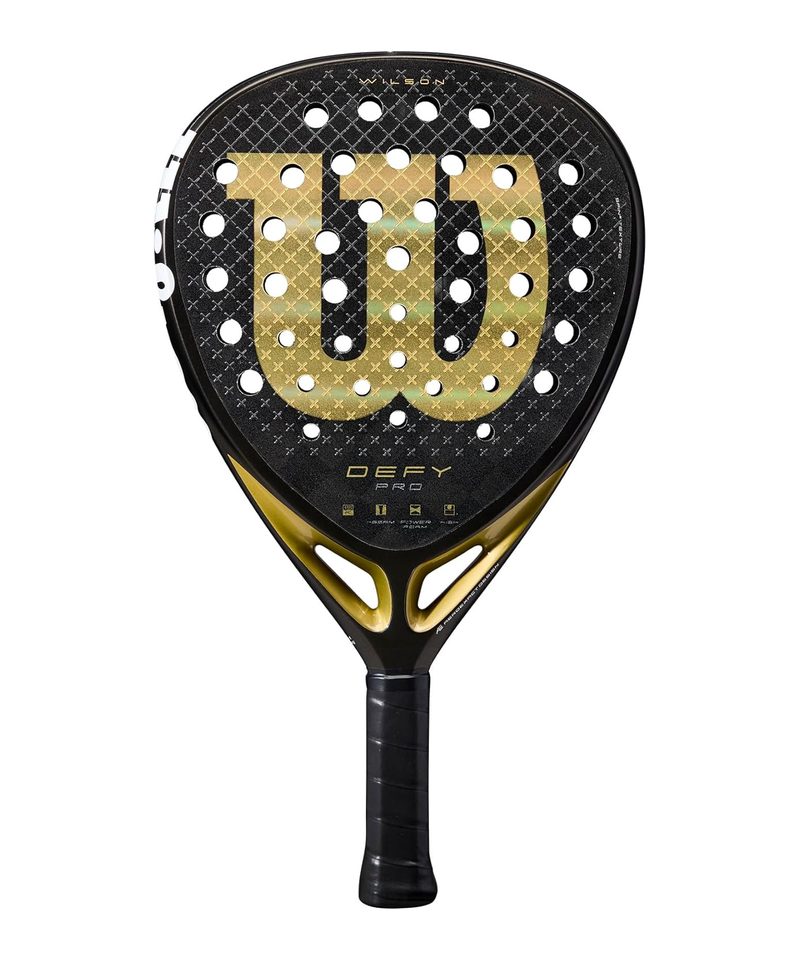
Why it wins: A 370 g diamond with a 15K carbon face and Power Foam core, built for advanced players who finish points at the net. (~$349)
- Diamond shape with Aeroexact aerodynamics
- 15K carbon face and C2 tubular carbon frame
- Duo Grid holes: power on top, spin below
- 370 g (+/- 10 g), 265 mm balance
Main features of the Wilson Defy Pro V1
The Pro V1 is built to hit hard without feeling clumsy in the hand:
- Diamond head shape, so the sweet spot sits high and the racket is at its best on overheads and smashes
- 15K carbon face for a firm, fast response and consistent ball exit
- C2 tubular carbon frame with an even wall thickness around the head to resist twisting
- Duo Grid hole pattern: larger holes at the top for power, smaller holes at the bottom for spin and control
- Spin2 texture on the face to hold the ball a fraction longer and add spin
- Power Foam core, Wilson’s foam tuned for a quick, energetic rebound
Specification of the Wilson Defy Pro V1
Here are the full specs of the Wilson Defy Pro V1:
- Shape: Diamond
- Weight: 370 g (+/- 10 g)
- Balance: 265 mm
- Beam thickness: 38 mm
- Core: Power Foam
- Face: 15K carbon
- Frame: C2 tubular carbon
- Holes: Duo Grid pattern
- Surface: Spin2 texture
- Player level: Advanced
- Type of play: Power / attack
Our review of the Wilson Defy Pro V1
The Pro V1 is a power racket with a surprising amount of speed for its weight. A 265 mm balance keeps the head from feeling as heavy as many diamonds, so it accelerates quickly through the swing and is easy to reposition at the net. The firm 15K carbon face turns a clean strike into a fast, flat ball, and the Spin2 texture gives the kick smash and the vibora some extra bite.
That firmness has a price. Defensive blocks and lobs from deep in the court do not get much help from the racket, so you supply the pace and the depth. The usable hitting area is also smaller than the shape suggests: the best contact sits high and central, and shots that drift towards the edges lose depth quickly.
For a player who already centers the ball and likes to attack, that trade is a good one. For anyone still building consistency, the standard Defy V1 or the lighter LS is the better fit.
Pros
- Fast, heavy-feeling power with quick handling
- Very good spin from the Spin2 face
- Stable frame that resists twisting
- Strong on overheads, smashes and volleys
Cons
- Firm face gives little help on blocks and lobs
- Small high-performance zone
- Not forgiving of off-center hits
- Priced at flagship level
Who is the Wilson Defy Pro V1 for?
The Pro V1 suits advanced and competition players, especially those on the left side of the court who take most of the overheads and finish at the net. If you already play a diamond and want more speed and spin without going much heavier, it is a natural step. Improving players who want the same shape at a lower price should look at our intermediate picks first.
Who the Wilson Defy Pro V1 is not for
Skip it if you are new to padel, if you rely on blocking and lobbing to stay in points, or if your timing still varies from shot to shot. The firm carbon face is also unforgiving on the arm if you are prone to elbow trouble, and our tennis elbow racket guide lists softer options.
What to know before you buy the Wilson Defy Pro V1
Weight and balance in practice
370 g is at the heavy end of the range, but the 265 mm balance point keeps most of that weight in your hand rather than out in the head. Players moving up from a light teardrop usually notice the mass on long rallies first, so plan on a few sessions to build the strength for it. The tolerance on weight is +/- 10 g, so two rackets off the same shelf can differ slightly.
The Duo Grid face and where to hit it
The larger holes near the top of the face give the racket its pop on overheads, while the smaller holes lower down favor control and spin. Practical advice: aim to meet the ball around the upper middle of the face on smashes and bandejas, and keep the racket head up on volleys so you stay in that zone.
Where it sits in the Defy range
The Pro V1 is the top model. The standard Defy V1 uses a 3K carbon face at 365 g and is the softer, more comfortable choice, and the Defy LS drops to about 355 g for intermediate players who value maneuverability. All three share the diamond shape, so the choice comes down to face hardness, weight and how much help you want from the racket.
How the Wilson Defy Pro V1 plays
On overheads and smashes it is at its best. The high sweet spot and firm face send the ball out fast, and the texture helps a kick smash bounce awkwardly off the back wall.
On the bandeja and vibora it gives you the spin you want when you have time to set up. Our guides to the bandeja and the vibora explain the technique.
At the net it is quick and precise, though you have to punch the volley rather than block it. In defense it is the weakest part of the package, because the racket returns little energy by itself.
Wilson Defy Pro V1 vs the alternatives
Wilson’s other flagship, the Bela Pro V3, is a round, control-first frame, so the two suit very different games. Among diamonds from other brands, the Adidas Metalbone 3.4 is a comparable power racket, and the Head Coello Pro offers a similar advanced attacking profile. Our best rackets for advanced players guide compares the full group.
Is the Wilson Defy Pro V1 worth it?
At around $349 it costs less than several rival flagships and delivers a lot of speed and spin. It is worth it if you attack, hit the ball cleanly and want a heavy, stable diamond. It is poor value if you are still developing your game, because most of what you pay for only shows up when your contact is consistent.
Conclusion
The Wilson Defy Pro V1 is a fast, heavy, spin-friendly diamond that rewards advanced attackers and punishes loose contact. Its main strengths are overhead power, spin and a stable frame. Its main weaknesses are a firm face that helps little on defense and a hitting zone that is smaller than the shape suggests.
If that describes your game, it is one of the strongest Wilson frames on sale. If you want the shape with more comfort, see the Defy LS, or browse our best padel rackets roundup for every level.
Frequently asked questions about the Wilson Defy Pro V1
No. It is an advanced racket with a firm 15K carbon face and a heavy 370 g weight. Beginners will get more from a forgiving round racket, and our beginner padel racket guide lists good starting points.
All three are diamonds. The Pro V1 has a 15K carbon face and weighs 370 g. The standard Defy V1 uses a 3K carbon face at 365 g and feels softer. The LS V1 is the lightest at 355 g and is aimed at intermediate players.
It weighs 370 g with a tolerance of plus or minus 10 g, and the balance point is 265 mm. That makes it one of the heavier rackets in Wilson’s range, although the balance keeps it manageable.
It is a firm racket. The 15K carbon face and stiff frame transmit more feedback than a soft foam racket, so players with elbow or shoulder problems may prefer a more forgiving frame. Good technique and a suitable overgrip help.
It suits attacking players, which usually means the left side, where you take most overheads and finish points at the net. Right-side players who like to attack can use it too, but they give up some defensive help.
The holes are not all the same size. Larger holes at the top of the face help produce power on overheads and smashes, and smaller holes lower down favor control and spin on shots from the middle of the face.
Yes for an advanced attacker who wants a heavy, stable diamond with good spin. No for a developing player, since most of the benefit depends on clean, consistent contact.
It is sold in one grip size, size 2 (4 1/4 inches). If the handle feels thin, adding an overgrip builds it up slightly, and our guide to changing a padel grip shows how.

Lucas Sánchez is the founder of SimplePadel. Born and raised in Spain, Lucas has been living in the US and UK for the last 20 years and currently calls Miami his home. While he’s never played professionally, the dream is still alive.
Lucas loves nothing more than playing (and talking) about padel, and he considers himself lucky to have a wife and family that share his love for the game.