
Padel is one of the fastest-growing sports in the United States right now — and if you’ve never played before, you’re in the right place. Originally invented in Mexico in 1969, padel has exploded globally and is now reaching every corner of the US, from California to Florida to New York.
This guide covers everything a complete beginner needs to know: the rules, the court, the equipment, and how scoring works. By the end, you’ll be ready to step on the court with confidence.
What is Padel?
Padel is a racquet sport that generally follows the rules of tennis, but it has four walls like squash which makes it different. It’s played inside an enclosed court, so there are less limits to where you can hit the ball.
If you are already playing tennis and enjoy it, chances are that padel will also appeal to you. The foundation of the game is based on good positioning and strategy, using speed and accuracy to place the ball where it will put your opponent under pressure.
Quick Facts about Padel
- Padel is played in doubles. A normal Padel court is designed for four players and is roughly 25-30% smaller than a tennis court. There are also single courts, but it’s less common.
- Padel rules are similar to those of tennis, but you serve underarm. Points are calculated the same as in tennis with points, games, and sets. Tiebreak is used to separate teams at 6-6.
- Padel balls are smaller and has less air pressure than tennis balls.
- Padel racket: Solid with no strings. The racket has to be perforated.
Is Padel Easy to Learn?
Yes — padel is widely considered one of the most beginner-friendly racket sports out there, and most players are having fun rallies within their very first session. Here’s why:
- The court is enclosed. Glass and mesh walls mean the ball stays in play longer, which naturally creates longer rallies for beginners. You don’t need powerful groundstrokes to have a good game.
- No overhead serve. Padel uses an underarm serve only, so you skip one of the most technically difficult parts of tennis right from the start.
- You play in doubles. Four players on the court at all times means you cover less ground and have a partner to rely on — far less exhausting than singles tennis.
- Smaller court, more action. At roughly a third the size of a tennis court, you’re always close to the action. Beginners make contact with the ball far more frequently than in tennis.
The main learning curve is getting comfortable playing the ball off the back glass — something that feels strange at first but becomes second nature quickly. If you’ve played any racket sport before (tennis, squash, pickleball), you’ll feel at home within minutes.
Padel explained in 2 minutes
The Padel Court
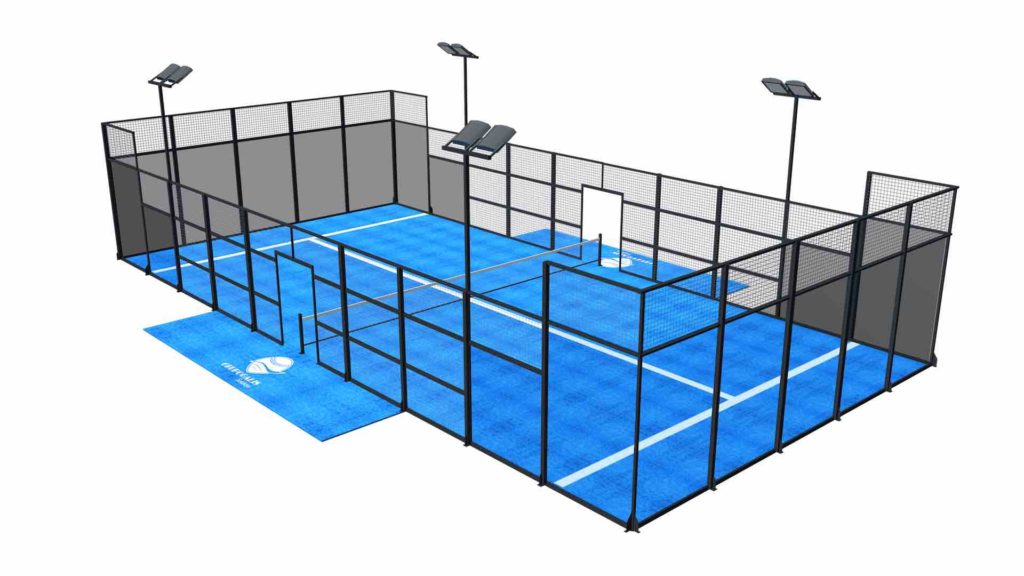
The court is enclosed and is surrounded by walls of glass and metallic mash. The dark grey areas in below image indicates what on the court that is glass.
The ball can bounce off any wall but can only hit the turf once before being returned.
Dimensions of the court
The Padel court is 20 meters long and 10 meters wide, with back walls of glass up to a height of 3 meters, whereas the glas side walls end after 4 meters.
The walls might be made of glass or another hard substance like concrete. A metallic mesh at a height of 4 m is used to finish the rest of the court.
There is a net in the center of the court that separates it into two halves. The maximum height is 88 cm in the middle, with 92 cm on each side. A line runs down the center of these fields. The service zone is defined by another three-meter line from the back wall.
Recommended reading:
Padel equipment
The padel racket
Generally, padel rackets are made of carbon fiber or fiberglass. More advanced players normally prefer rackets with carbon fiber whereas beginner players would be more suited to start with bats made out of fiberglass.
Padel rackets are available in different shapes:
- Round
- Drop-shaped
- Diamond-shaped
A round padel racket is a popular choice for most players, from beginners to expert competition level players, and is often referred to as the control racket. It’s simple to use and provides good control, precision, and speed.
The sweet spot is more central, making the racket easier on hand while still providing a nice sensation.
A diamond-shaped padel racket is designed to provide power and speed, and it is typically used by advanced, offensive players.
The sweet spot on a diamond-shaped racket lies near the outer edge. Because the racket is slightly more difficult to use, it is ideal for more advanced players.
A drop-shaped padel racket (also called a hybrid racket) combines the characteristics of the round and diamond-shaped rackets, and is suitable for players who are more all-round.
Just getting started?
Check out our guide to the best padel rackets for beginners — we cover the top options available on Amazon US at every budget.

Padel balls
One of the most common misconceptions is that a padel ball is the same as a tennis ball. It is not!
A padel ball is slightly smaller and has less pressure which alters how high the ball will bounce.
How Much Does Padel Cost in the US?
Padel is accessible at every budget. Here’s what to expect when you’re just getting started:
- Court rental: Typically $15–30 per person per hour, depending on the facility and city. Many clubs offer group lessons for less.
- Racket: A solid beginner padel racket costs $50–120 on Amazon US. You don’t need to spend more to start. See our best beginner racket guide.
- Balls: A tube of padel balls costs $8–15. They’re usually shared, so you may not even need to bring your own.
- Shoes: Any non-marking court shoe works to start. Dedicated padel shoes ($60–150) have extra lateral support but aren’t essential for beginners.
Many US clubs offer a free trial session or equipment rental — check our US padel guide to find courts near you.
Quick rules to get started
- The lines on the court are used only at the serve (service line).
- The serve may not bounce up in the fence but it may bounce up in the glass walls.
- If you are the server, you have two serves to complete the serve. The first serve, and the second service. Missing both gives away a point to the opponent and is called “a double fault” (two consecutive service faults) as in tennis.
- The points count (15, 30, 40, game) works the same way as in tennis.
- Playing volleys are allowed but not directly on the return of the serve.
- The serve is hit diagonally underhand and should bounce in the opponent’s server box.
- You can hit the ball in the glass wall on your own half of the field before it reaches the opponent’s half of the field.
- You must not hit the ball in the fence on your own side.
- You can let the ball bounce in the fence and glass wall before you hit it.
The scoring system / point system
The scoring system for padel is exactly the same as for tennis. You normally play a game in best of three (best of three sets is the official rule) or five sets, and count points (within a game), games (within a set), and sets.
If the score is 40-40 (also called deuce) in a game, you will need to win two more points to win the game. The first point won is referred to as the advantage, and the second point wins the game.
If you first win the advantage, meaning 40 (advantage)-40, and then lose the next point, the score goes back to being 40-40.
There’s also an alternative rule called “The Gold Point” (or El Punto de Oro in Spanish) where no advantage is played. This was first introduced in 2020 on the World Padel Tour to add more excitement and create shorter games.
The first team to get six games wins the set. If the score in a set is 6-6, you play a tie break game to decide who the winner of the set is.
During tie-break, the points “zero”, “1”, “2”, “3”, etc., are called. The “tie-break” will be won by the first players to win 7 points, as long as it is with a 2 point advantage. If necessary, the tie-break continues until this margin is obtained.
The “tie break” will be started by the player whose turn it is to serve, according to the order followed in the set. This player will only have one serve taken from the right side of court.
The following two points will be served by the players of the opposing team respecting the previous order of service and serving from the left. After this, the players will serve two consecutive points until the end of “the tiebreak” always respecting the aforementioned order of service.
Winning the game
You and your partner win the game when you have won two sets (in a best of three sets game) or three sets (in a best of five sets game).
How to win the point in Padel
- You win a point each time your opponent hits the ball directly into their own net.
- You win a point each time the ball bounces twice on the ground in the opponent’s half of the field.
- You win a point if the opponent hits the ball in his own fence.
- You win a point if the opponent knocks the ball out of the court, for example, if it comes outside the court itself or goes directly into one of the walls.
- You win a point if one of your opponents is hit by the ball, e.g. you smash the ball in the back on a player. That’s your point!
Recommended reading:
How to lose the point in Padel
- You lose a point if the ball first hits the wall before it touches the ground. However, you may shoot the ball into your own wall after it has bounced.
- You lose a point every time the ball bounces more than once on your own half of the field. This also applies to the serve.
- If the ball goes directly into the net on your own side, you also lose a point.
- If ball hits your racket twice in a shot, you lose a point.
- You also lose a point if the ball hits either you or your teammate.
- You lose a point if you do two consecutive server misses (a double fault).
- If you or your opponent touches the net in any way, either with your body or with your racket, you lose a point.
Recommended reading:
How to serve
When you’re on the serving team, the game is started by serving the ball from the right side of the court.
The serve must bounce once on your side of the field before you hit it to the opponents court.
You serve diagonal to the other side and must hit it to the left of the center service line (serving from the right).
Recommended reading:
Hitting the so called service box to the left in this example. Hitting the central line or back line of the service box is counted as a good serve.
You score a point if the opponent fails to hit the ball back over the net.
5 Tips for Your First Padel Game
Technical skill matters less than you think at the beginner level. Here’s what actually helps in your first few sessions:
- Start at the net, not the baseline. Padel is won and lost at the net. Advance forward after the serve rather than camping at the back — you’ll win far more points.
- Don’t smash everything. The instinct is to hit hard. In padel, placement beats power. A controlled ball into a corner beats a flat smash that flies out every time.
- Use the back glass. When you’re pushed back, let the ball come off the back wall and play it from there. It’s part of the game — not a mistake.
- Communicate with your partner. Call “mine!” or “yours!” early. Good positioning as a pair is the foundation of every winning rally.
- Watch the ball, not your opponent. Beginners regularly lose track of the ball after it bounces off the glass. Eyes on the ball, feet follow.
Want to go deeper? Our guide to padel shots explained breaks down every stroke from the lob to the bandeja. Or read our tips on how to win more points as a beginner.
Ready to Play Padel?
Now that you know the basics, you’re ready to step on the court. Padel rewards smart positioning and teamwork more than raw power — so don’t worry if you’re not naturally athletic. Most beginners are having long rallies within their first session.
A few things to do next:
- Find a court near you — browse our US padel guide for courts by state
- Get the right racket — see our picks for the best beginner padel rackets
- Learn the serve — our complete serve rules guide breaks down every detail
Good luck on the court!
Frequently Asked Question about the Rules of Padel
If one of your opponents fails to return the ball over the net and your ball is good, you win the point. If your opponent miss (e.g. miss the ball, hit the ball into the net or back wall) you win the point. If your opponents miss two straight service, you win the point.
You can’t hit the fence on your own side in padel. But you can hit the fence if you for instance smash the ball onto your opponents side of the court and onto the fence.
Yes. You can hit your own back wall in padel. You can however not hit the ball into your opponents back wall without the ball bouncing on their side of the court first.
You score if your opponent miss (e.g. miss the ball, hits in net), or if you win the ball.
Not necessarily, but it is a slower game than tennis. It’s quite easy to learn but takes a lifetime to master.
Yes, points are taken exactly the same in Padel as in tennis.
The best padel players in the world compete on the Premier Padel tour — the sport’s top professional circuit, which replaced the World Padel Tour (WPT) in 2023. In the US, the sport is governed by US Padel (USPA), which organises national tournaments and leagues.
Yes! This is one of my favorites. As an amateur, you don’t get the chance to pull off one of these very often, but out-of-court plays in tournaments are fairly common.

Isabella Torres is originally from Madrid, Spain, and has been playing Padel as a semi-professional for the past five years. After completing her education as a journalist, she discovered her true passion in life was writing about Padel.
She loves staying up late watching intense rallies on YouTube, and is excited to share her knowledge about the sport with SimplePadel’s readers.
16 replies on “How to Play Padel: A Complete Beginner’s Guide (Rules, Scoring & Tips)”
[…] Rules of padel can be confusing, especially if it’s your first time to play padel. Determining valid or invalid shots, and understanding the point system, is difficult. […]
[…] Let’s look go over the basics and benefits of playing Padel. We’ll look at how to find your local padel court, how to motivate children and get them into sports, and the Padel rules for beginners. […]
[…] may be a descendant of other racket sports like tennis, but it is its own game with its set of rules, play styles, and strategies for […]
[…] the future, you can expect that there are new rules to spice up padel games, similar to how the World Padel Tour proposed the gold decisive […]
[…] The Grand Sports Club offers 5 double courts, private lessons and a Padel Academy where beginners can come and learn the game of padel with one of their instructors. The academy is designed to teach the basics and fundamentals of padel. […]
[…] courts, roughly one-third of a tennis court size at first glance. You can look into the official rules of Padel […]
[…] How to Play Padel: Everything you need to know […]
[…] origins in our rearview mirror, let’s now dive into the heart of the matter and discuss padel game vs pickleball in detail and try to understand how these delightful games are […]
[…] rules and tips, check out this comprehensive guide on how to play Padel, or learn more about the equipment specifics. If you’re looking to get started, the article All About Padel: FAQs and Answers […]
[…] playing surface is often made of composite materials that provide durability and proper ball rebound. Some courts use artificial turf with sand infill […]
[…] is a fast-paced game typically played in doubles. The scoring system is similar to tennis, with points, games, and sets. You serveThe Serve is the shot that starts the point in padel. […]
[…] may seem challenging at first, but it’s actually quite easy to pick up and play. The rules are similar to tennis, but with a few key differences that make it more accessible. You serveThe Serve is the shot that […]
[…] Padel Craze Hits the U.S.: Is This the Next Big Racket Sport? […]
[…] Welcomes New Padel Courts, Expanding Outdoor Sports […]
[…] https://simplepadel.com/how-to-play-padel/ […]
[…] tabel hieronder, gebaseerd op een analyse van spelsituaties, geeft een helder overzicht van de meest voorkomende […]