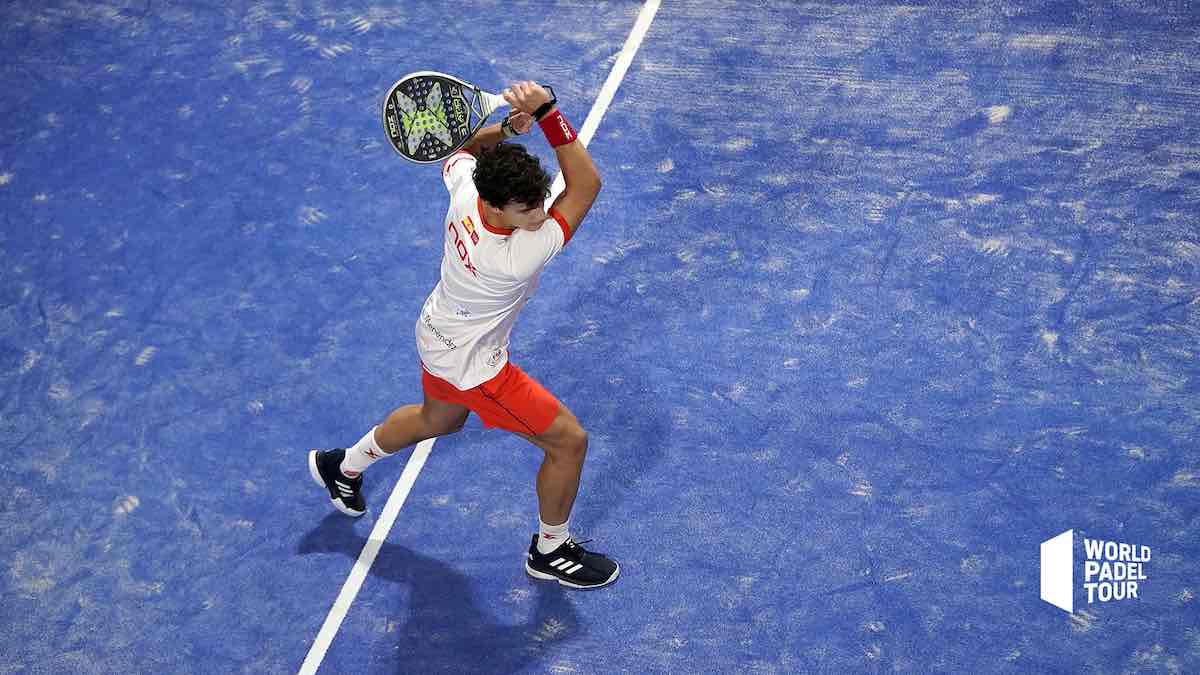
The serve is the one shot in padel you always start a point with, and the one beginners get wrong most often. Unlike tennis, a padel serve has to be underarm, below the waist, bouncing off the floor first, and landing diagonally in the opponent’s service box. If any of those conditions slip, the serve is a fault.
A legal padel serve is hit underarm, struck below the waist (at or below 1.06 m from the ground under current FIP rules), after letting the ball bounce once on the server’s side of the court, and landed diagonally in the opponent’s service box on the first bounce. The server stands behind the service line, with at least one foot on the ground, and must not step on or over the line before contact. Each server gets two attempts per point. A ball that touches the net and lands in the service box is a let and is replayed.
This guide covers every padel serve rule you need to know: how to stand, what counts as a fault, when a let is called, how the tie-break rotation works, and the 2024 FIP rule changes that clarified the serve height. It also explains the two most common serve variations (underarm and backhand) and the foot-fault situations that catch every new player out.
Padel Serve Rules at a Glance
| Serve type | Underarm only (no overhead serves) |
| Contact point | At or below 1.06 m (waist level) – FIP rule clarified in 2024 |
| Ball bounce | Must bounce once on the server’s side before contact |
| Server position | Behind the service line, between side wall and centre line; at least one foot on the ground |
| Target | Opponent’s service box, diagonally across |
| Attempts per point | Two (first serve and second serve) |
| Let (replay) | Ball clips the net and lands in the service box – replay the serve |
| Serving side rotation | Right box for even-numbered points (0, 2, 4…), left box for odd (1, 3, 5…) |
How to Serve in Padel: The Step-by-Step
- Stand behind the service line, between the side wall and the centre line of your service box. Keep at least one foot on the ground.
- Drop the ball so it bounces once on the court on your side.
- Strike the ball underarm, with contact at or below waist level (1.06 m / about 42 inches from the ground).
- Aim diagonally into your opponent’s service box on the other side of the net.
- The ball must bounce in the service box on the first bounce after your serve. If it bounces and then hits the back wall or side wall before the returner plays it, that’s still fine – but a direct hit on the side wall mesh is a fault.
If it all goes right, the point starts. If it doesn’t, it’s a fault, and you take your second serve.
How to Position Yourself for the Service
The server stands behind the service line. Your feet must be positioned in the area between the service line, the centre line, and the side wall. You cannot stand with either foot on or across the service line at the moment you strike the ball – that’s a foot fault.
Static vs. dynamic service
A static serve is delivered with both feet planted behind the service line. This is the standard way to serve.
A dynamic serve is allowed too – you can take a small step or shuffle during the motion – provided at least one foot stays on the ground throughout, and neither foot crosses the service line before the racket makes contact with the ball. No jump serves.
As the person serving
Your preparation matters as much as the motion itself. Establish your stance, bounce the ball once, and strike cleanly. If you’re rushing the serve, you’re making more errors than you need to.
Examples of bad service you must avoid
- Serving overhead (this is a tennis-style serve; not allowed in padel)
- Hitting the ball above waist level (above ~1.06 m)
- Skipping the bounce (you must let the ball bounce first)
- Standing on or over the service line at contact
- Both feet off the ground at contact (no jump serves)
- Serving the ball directly into the side wall mesh before it bounces in the service box
- Serving into the wrong service box
The first serve is a fault if
- The ball doesn’t land in the correct service box
- You commit any of the motion faults above (foot fault, overhead, above waist, no bounce)
- The ball hits the back wall without bouncing in the service box first
- The ball hits the side wall mesh before crossing the net
Two consecutive faults in the same point is a double fault: the point goes to the returning team.
Other conditions that call for a let
- The ball clips the top of the net cord, lands in the correct service box, and the play continues legally – this is a “net serve” or “let serve” and is replayed
- The returner isn’t ready and signals so before the serve
- An outside interference (another ball rolls onto the court, a bird flies through, etc.)
As the receiver of the serve
The returner stands anywhere in their side of the court, typically just behind the service line in the diagonally opposite box. You have to let the serve bounce once on the court before returning – you can’t volley a serve out of the air.
A return is considered correct if
- You let the serve bounce first
- You strike the ball after the bounce but before it bounces a second time (or before it bounces off the back wall and then the ground twice)
- The return crosses the net and lands in the opponent’s court area (it doesn’t have to land in any specific box on the return)
After the serve is returned, the rest of the rally follows normal padel rules – balls can bounce off the walls, but only once on the ground per shot.
What Are Illegal Serves in Padel?
The quick list of serves that are automatically a fault:
- Overhead (tennis-style) serves – not allowed. The arm must stay low and the racket below waist level.
- Serves without a bounce – you can’t serve directly out of the air. The ball must bounce once on your side first.
- Jump serves – both feet must not leave the ground at contact.
- Foot faults – stepping on or over the service line, side wall, or centre line before contact.
- Serves hit above waist level – the current FIP rule sets the maximum contact height at 1.06 m.
- Serves hitting the side wall mesh before the service box – the ball must land in the service box first.
Is a Drop Serve Legal in Padel?
Yes, and every padel serve is technically a drop serve. In padel, you always drop the ball, let it bounce once on the court, and then strike it. That’s the only legal motion.
In tennis, “drop serve” refers to a specific optional motion where the server drops the ball instead of tossing it. In padel, that’s the default and only allowed motion. There is no toss-and-hit serve in padel at all.
The Underarm Serve
The underarm serve is the default and mandatory serve motion in padel. Everything about the serve is built around keeping the racket below the waist at contact.
Key technique points:
- Contact point: below 1.06 m, ideally around hip height
- Grip: continental (hammer grip) – the same grip you’d use for volleys. See our padel tips guide for more on grips.
- Swing: short and smooth; no big windup
- Follow through: forward and slightly up to generate control
The Backhand Serve
A backhand serve is legal in padel as long as it still meets all the other serve rules (underarm motion, ball bounces first, contact below waist, feet behind the line). It’s used less often than the forehand underarm serve, but can be effective for adding an unexpected angle – especially on the ad side (left service box).
Most recreational players stick to a forehand underarm serve because it’s more consistent. Advanced players often mix in the backhand serve to keep returners guessing.
How High Can You Bounce the Ball Before Serving?
There’s no specific rule limiting how high you can bounce the ball before serving. You can drop it from a comfortable height and let it bounce as high as it wants. The only restriction is the contact point: when you strike the ball, the racket and ball must be at or below 1.06 m.
In practice, most players drop the ball from roughly waist height so it bounces back up to around knee-to-hip level, where they strike it at the top of the bounce or just as it starts coming down.
The Lines That Matter for the Serve
A padel court has three key lines around the serve:
- Service line: runs parallel to the net, 3 metres from the back wall. The server stands behind this line.
- Centre line: runs perpendicular to the net, splitting the service area into left (ad) and right (deuce) service boxes.
- Side line (side wall): the outer boundary of the service box.
Can the ball cross the centre line after the bounce?
Yes. After the serve has bounced in the correct service box, the ball can then cross the centre line (often bouncing off the side wall and rolling across) and be legally returned. What matters is that the first bounce lands inside the correct service box. After that, normal rally rules apply.
The Service Is Diagonal into the Opponent’s Box
As in tennis, the padel serve must cross the net diagonally and land in the opposite service box:
- If you’re serving from the right (deuce) side, the ball must land in the opponent’s right service box (diagonally across).
- If you’re serving from the left (ad) side, the ball must land in the opponent’s left service box (diagonally across).
Players alternate service boxes after each point, so the server switches side every point throughout their service game.
Padel Scoring: How the Serve Fits the Match
Padel scoring is identical to tennis scoring:
- Points: 0 (love), 15, 30, 40, game
- Deuce at 40-40
- Advantage scoring: after deuce, one team must win two points in a row – OR, under the golden point rule, the receiving team chooses the return side and the next point decides the game
- Games: first team to 6 games (with a 2-game lead) wins the set
- Tie-break at 6-6
- Match: best of 3 sets
Each game, one team serves every point until the game ends. Serve rotation moves to the other team at the start of each new game. Within a team, partners alternate service games – so you serve once every four games across a match.
Service in a Tie-Break
When a set reaches 6-6, play goes to a tie-break (first to 7 points with a 2-point lead).
Who starts to serve in the tie-break?
The player whose turn it was to serve next in the normal rotation starts the tie-break. They serve one point (from the deuce/right side), then serve rotates:
- First point: Starter serves from the deuce side (right)
- Points 2 and 3: The next player in the serving rotation serves both points – one from the ad side, one from the deuce side
- Points 4 and 5: Next player serves both points, same pattern
- Points 6 and 7: Next player serves both points
- Continue in pairs of two, always starting each player from the ad side (except the very first serve)
Players change ends every 6 points during the tie-break.
For more on how tie-breaks work, see our padel tie-break guide.
Recent FIP Rule Changes to the Serve
The International Padel Federation (FIP) clarified the serve height rule in its 2024 rules update, setting a firm 1.06 m (waist level) maximum contact height. The rule hadn’t previously been specified to the millimetre, and some professional matches had seen disputes over whether a serve was hit too high.
In practical terms for recreational players, the rule is unchanged – hit the ball at or below waist level. But officials at professional tournaments now have a concrete number to reference.
How to Improve Your Padel Serve
- Consistency before power. A soft, well-placed serve wins far more points at club level than a hard serve that lands short or long.
- Target the body or the T. Aim at the returner’s body or the centre T to force awkward returns. Wide serves are often easier to attack because the returner can use the side wall.
- Add spin to the second serve. A little slice or topspin makes the serve harder to return cleanly. See our guide on padel spin.
- Serve-and-volley. After serving, move forward to take the net. This is the main strategic advantage of serving in padel – you’re one step ahead in the race to the net.
- Practice the bounce. A consistent ball drop is the foundation. Practice letting the ball bounce at the same height every time.
For more beginner strategy, see our padel tips for beginners.
Conclusion
Padel’s serve rules are strict but learnable: underarm, below waist, bounce first, diagonal into the opponent’s box, foot on the ground. Master those mechanics and you’ll stop giving away free points on your own serve – which alone improves most beginners’ win rate more than any other single skill.
If you’re new to the sport, start with our how to play padel guide for the full rules overview. If you want to stop getting burned on serve, our padel tips guide has the tactical side.
Frequently Asked Questions about the Padel Serve
A padel serve must be hit underarm, with contact at or below waist level (1.06 m under current FIP rules), after the ball has bounced once on the server’s side of the court. The serve has to land diagonally in the opponent’s service box. The server stands behind the service line with at least one foot on the ground, and gets two attempts per point.
Underarm only. Drop the ball, let it bounce once on your side of the court, then strike it with the racket below waist level, aiming diagonally into the opponent’s service box. Overhead (tennis-style) serves are not allowed.
Overhead serves, serves hit above waist level, serves without a first bounce on your side, jump serves (both feet off the ground), foot faults (stepping on or over the service line before contact), and serves that hit the side wall mesh before landing in the service box are all illegal.
Yes. Every padel serve is a drop serve. You must drop the ball and let it bounce once on the court before striking it. There is no toss-and-hit serve in padel.
At or below waist level. The FIP clarified this in 2024 as a maximum contact height of 1.06 m from the ground. If the ball or racket is above that height at contact, the serve is a fault.
If the ball clips the net and lands in the correct service box, it’s called a let (or ‘net serve’) and the serve is replayed. If the ball hits the net and lands outside the service box or doesn’t cross the net, it’s a fault.
Only after bouncing in the correct service box. If the serve lands in the box and then rebounds off the side wall, the ball is still in play and the returner plays it. But if the ball hits the side wall directly without bouncing in the service box first, it’s a fault.
Two. If the first serve is a fault, you serve a second serve. If the second serve is also a fault, the point goes to the receiving team (a double fault).

Patricia Nguyen is a former pickleball player who joined SimplePadel as a Content Writer in late 2022. She lives in Texas with her two dogs and is an avid fan of the sport. Her favorite player is Ale Galán, whom she believes to be the best defensive padel player that ever played the game.
18 replies on “Padel Serve Rules: Complete Guide to Serving in Padel”
[…] Your Complete Guide to Serving Rules of Padel […]
[…] Your Complete Guide to Rules of the Serve in Padel […]
[…] height of the ball from the ground and speed affect how well your Padel serve, and spinning can […]
[…] run through the fundamental positions, swinging force, Padel rules of the serve, and ways of ensuring that your service leaves your opponents stumped and your audience […]
[…] It is worth mentioning that this padel racket is suitable for all types of strokes including forehand, backhand and serve. […]
[…] can try to play normal padel but within the service lines as a half court game. This is also a great way of playing padel with […]
[…] Your Complete Guide to Serving Rules of Padel […]
[…] The Complete Guide to Padel Serve Rules […]
[…] Serving rules of Padel […]
[…] The approach of Paquito Navarro on the overall design of the Bullpadel Hack 03 2022 is very personal. Paquito Navarro is a backhand player famous for his ability to attack after defending, and also for his backhand serve. […]
[…] One feature we felt good about the Bullpadel Indiga CTR 22 racket for attacking players is its inner core, which is made of SoftEva rubber, which is great when returning and receiving shots while keeping maximum control. However, it’s quite hard getting the power you need on the serve. […]
[…] The Carbon flex and EVA hitting surface materials allow the racket to make contact with the ball more frequently, improving your spinning and serving abilities […]
[…] extended length and grip size gives the player an advantage on the serve-greater impact, and longer reach for a better speed range […]
[…] below the waist. Similar to tennis, the serve must cross into the opponent’s square. Players serve twice in Padel. However, the receiving player cannot hit a volley, as the ball must bounce […]
[…] Serve and Score is a game that focuses on serving skills and accuracy. Set up targets on the opposite side of the net, assigning different point values to each target. Players take turns serving and aim to hit the targets. The points are awarded based on the accuracy of their serves. This game not only helps kids improve their serving technique but also encourages them to strategize and aim for specific targets to maximize their scores.Source: simplepadel.com […]
[…] Your Complete Guide to Rules of the Serve in Padel […]
A question: If server serves the ball to the for hands rectangle ( pre decided) but the player in the backhand side returns the serve will that cause the receiver players loose point!
That is correct.