
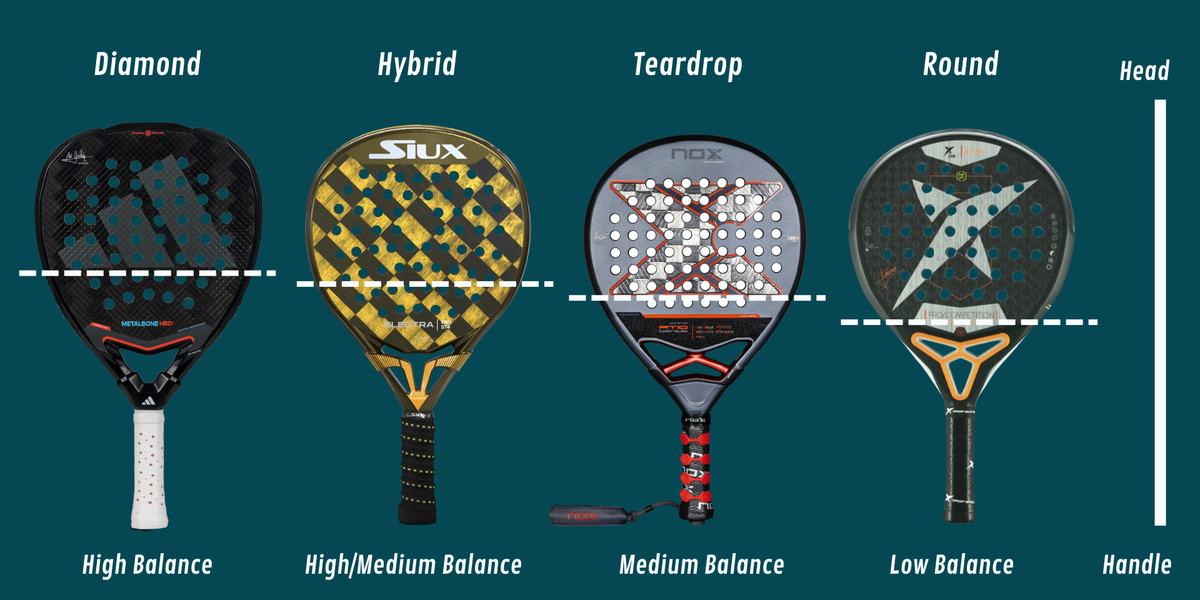
Padel rackets come in three shapes — round, teardrop and diamond — and the shape is the single biggest clue to how a racket plays. It sets where the balance and the sweet spot sit, which decides whether a racket leans toward control and forgiveness or raw power. But shape is only half the story: weight, balance, core density and the face material all change the feel too.
This guide explains every padel racket type and shape in plain English, walks through the specs that actually matter, and shows you how to match a racket to your level and playing style.
The three padel racket shapes
Shape determines the balance point, and the balance point determines the trade-off between power and control. Here’s the quick version:
| Shape | Balance | Sweet spot | Power vs control | Best for |
|---|---|---|---|---|
| Round | Low / even | Large, centred | Control & forgiveness | Beginners, control players |
| Teardrop | Medium | Medium, slightly high | Balanced | All-rounders, improvers |
| Diamond | High (head-heavy) | Small, high | Power | Advanced, attacking players |
Everything else about a racket — weight, core, materials — fine-tunes that basic shape character. We’ll cover those after the shapes.
Round padel rackets — control and forgiveness
A round racket places the sweet spot in the centre of the face and keeps the balance low, toward the handle. That gives it the largest, most forgiving sweet spot of any shape, the most manoeuvrability, and the easiest control — mishits are punished the least, and the lower balance is gentle on the arm.
The trade-off is power: because the mass sits toward the grip, a round racket won’t smash like a head-heavy frame. That’s a fair deal for the players it suits.
Best for: beginners, players who lead with placement and defence, and anyone prone to tennis elbow who wants a comfortable, arm-friendly frame.
Teardrop padel rackets — the versatile all-rounder
A teardrop sits in the middle. The balance is a touch higher than a round, and the sweet spot is a little larger and higher up the face, giving a genuine blend of power and control. It’s the most versatile shape and the one most players are happiest with.
Because it does a bit of everything, the teardrop is the safest pick for improving and intermediate players who don’t want to specialise yet — a teardrop like the Nox AT10 Genius is a good example of the all-round profile.
Best for: improvers and intermediate players, and anyone who wants one racket that can both attack and defend.
Diamond padel rackets — maximum power
A diamond pushes the balance high, toward the head, concentrating the mass exactly where you strike the ball. That delivers the most power of any shape — especially on the smash — but the sweet spot is smaller and sits high on the face, so off-centre hits feel harsh and the head-heavy balance is more demanding and tiring to swing.
Diamonds reward good technique and timing, which is why they’re the choice of attacking pros. Frames like the Adidas Metalbone, Bullpadel Vertex 04 and Head Coello Pro are classic power diamonds.
Best for: advanced, aggressive players who finish points at the net and can reliably find the sweet spot. Beginners should avoid them.
Beyond shape: the specs that change how a racket plays
Two rackets of the same shape can still feel completely different. These are the specs that fine-tune it:
Weight
Most padel rackets weigh 350–375 g. A lighter racket is easier to swing, quicker at the net and kinder on the arm; a heavier one delivers more power but tires you faster and stresses the elbow more. As a rule, lighter suits beginners, juniors and many women players, while stronger, advanced players can handle more weight.
Balance
Balance is where the racket’s weight is concentrated, from low (toward the handle) to high (toward the head). It’s closely tied to shape — round is low, diamond is high — but some rackets let you fine-tune it. Lower balance means more control and manoeuvrability; higher balance means more power.
Core and foam density
The inner core is usually EVA foam. A soft EVA core is more comfortable, forgiving and control-friendly — great for beginners and arm health. A hard EVA core is more explosive and precise but less forgiving, and suits stronger, advanced players. Some premium rackets use FOAM cores for a softer, livelier feel.
Surface and materials
The hitting face is usually fibreglass or carbon. Fibreglass is softer and more flexible — forgiving, comfortable and cheaper, ideal for beginners. Carbon is stiffer, more powerful, more durable and grippier for spin, but pricier and less forgiving. You’ll see carbon graded as 3K, 12K, 18K or 24K — higher numbers are denser and stiffer. A rough, textured surface also helps generate spin.
How to choose the right padel racket for you
Match the racket to your level and playing style rather than to your favourite pro’s gear — a touring professional’s diamond will hold most players back. A simple framework:
- Beginner: a round or teardrop racket, lighter weight, soft EVA core and a fibreglass face — forgiving, comfortable and easy to control.
- Intermediate / improving: a teardrop for a balance of power and control, edging toward carbon as your technique sharpens.
- Advanced: a diamond or teardrop with a carbon face and a firmer core, chosen around whether you favour power or control.
- By play style: control players and defenders lean round/teardrop with a low balance; attackers who finish at the net lean diamond with a high balance.
- On a budget? See our best budget padel rackets — you don’t need to spend big to get a great first racket.
Common mistakes when choosing a racket
- Buying a pro diamond too early. The small sweet spot and head-heavy balance will punish a developing game and can hurt your arm.
- Going too heavy. Extra grams add power but cost you control and tire your arm — start lighter and build up.
- Copying your favourite pro. Their racket is built for their game, not yours; match your level instead.
- Ignoring grip size and comfort. A frame that’s harsh or the wrong grip size leads to mishits and injury, whatever the spec sheet says.
The bottom line
Start with shape — round for control and forgiveness, teardrop for all-round versatility, diamond for power — then fine-tune with weight, balance, core and face material to suit your level. When you’re ready to pick a specific model, our best padel rackets roundup and our brand guides cover every shape and budget, and our level guides for beginners, intermediate and advanced players narrow it down further.
Frequently asked questions
Round, teardrop and diamond. Round rackets are control-first and forgiving, teardrops are balanced all-rounders, and diamonds are head-heavy power rackets for advanced players.
A round or teardrop racket. Both have a lower balance and a larger, more forgiving sweet spot that’s easier to control while you develop technique. Pair it with a lighter weight, a soft EVA core and a fibreglass face. Avoid diamonds until you’re more advanced.
Neither is universally better. Round rackets give more control, forgiveness and comfort and suit most players; diamond rackets give more power but are demanding and best for advanced attackers. Choose based on your level and whether you value control or power.
Balance is where the racket’s weight is concentrated. A low (handle-heavy) balance means more control and manoeuvrability; a high (head-heavy) balance means more power. Round rackets are low-balanced, diamonds are high-balanced, and teardrops sit in between.
Most are 350–375 g. Lighter rackets are easier to swing and kinder on the arm — better for beginners, juniors and many women players — while heavier rackets add power but tire you faster. Start lighter and increase weight as your game develops.
Fibreglass is softer, more forgiving and cheaper, making it ideal for beginners. Carbon is stiffer, more powerful, more durable and better for spin, but pricier and less forgiving — better suited to intermediate and advanced players.
Yes. Shape sets the balance point and sweet spot, which drives the power-versus-control trade-off and how forgiving a racket is. It’s the first thing to match to your level and playing style, before weight, core and materials.

Lucas Sánchez is the founder of SimplePadel. Born and raised in Spain, Lucas has been living in the US and UK for the last 20 years and currently calls Miami his home. While he’s never played professionally, the dream is still alive.
Lucas loves nothing more than playing (and talking) about padel, and he considers himself lucky to have a wife and family that share his love for the game.