You’ve booked the court, you’ve got your racket, and your partner just texted that they’re five minutes away. But before you step into that glass box and start swinging, there’s one thing that separates smart padel players from the ones nursing a shoulder injury by week three: a proper warm-up. With padel growing fast across the US — from purpose-built clubs in New York and Austin to pop-up courts in suburban tennis facilities — more players are learning this lesson the hard way.
Padel is a deceptively explosive sport. The glass walls, the low-bounce ball, and the fast net exchanges mean your body goes from zero to full effort in seconds. Without a proper warm-up, you’re asking cold muscles and stiff joints to handle hard sprints, sudden lateral changes, and overhead smashes. That’s a recipe for an injury that’ll keep you off the court for weeks.
This guide covers everything: the off-court dynamic warm-up you should do before you pick up a racket, the structured on-court ball warm-up, how long to spend on each phase, and what to do at the end to cool down properly. Let’s get into it.
Why padel requires a proper warm-up
Not all racket sports are created equal when it comes to injury risk. Padel sits at the more demanding end of the spectrum — here’s why.
The shoulder and rotator cuff take a beating in padel. Every overhead smash, every bandeja, every defensive lob generates rotational force through the shoulder joint. Play enough without warming up and you’ll accumulate micro-damage that eventually becomes a rotator cuff strain — one of the most common padel injuries at recreational level.
The elbow is another vulnerability. The repetitive impact of volleys, especially off the back glass when the ball comes in hard and low, loads the forearm tendons repeatedly. Lateral epicondylitis (tennis elbow) is a genuine risk for padel players who skip their arm warm-up.
And then there are ankles. Padel involves explosive lateral movements — diving for shots, changing direction suddenly, accelerating toward the back wall. A cold ankle that hasn’t been primed for that kind of load is a rolled ankle waiting to happen.
In sports medicine research, warm-up routines of 15 minutes or more have been shown to significantly reduce muscle and joint injury rates in racket sports. A five-minute jog and a couple of stretches isn’t enough. The body needs a progressive, structured ramp-up — and padel’s specific demands mean that warm-up needs to target the right areas.
Understanding good footwork in padel starts before you even step on the court — because footwork depends on warm, mobile joints and activated muscles.
Off-court dynamic warm-up (do this before you pick up the racket)
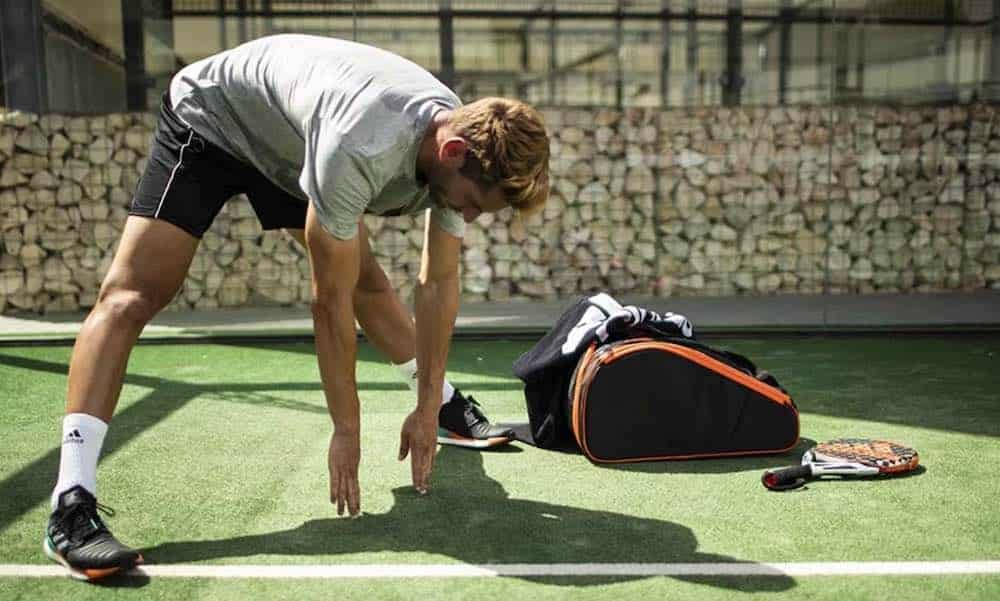
The best warm-up starts away from the court — in the hallway, on a patch of turf, or in the club car park. Before you touch your racket, spend 5–7 minutes doing a progressive dynamic warm-up that targets the key muscle groups padel will demand. Do not stretch statically at this stage — cold static stretching actually reduces power output. You want dynamic movement that gradually elevates your heart rate and temperature.
Leg swings
Stand next to a wall for support and swing one leg forward and back like a pendulum — 15 reps each side. Then turn to face the wall and do side-to-side leg swings, crossing in front of the body — another 15 reps per leg. This mobilizes the hip flexors, glutes, and hamstrings in the exact movement pattern you’ll use during lateral baseline sprints.
Hip circles
Feet shoulder-width apart, hands on hips. Make large circular rotations with your hips — 10 clockwise, 10 counterclockwise. This loosens the hip joint capsule and prepares you for the rotational demands of groundstrokes and smashes. Padel requires constant pivoting; stiff hips slow your reaction time and increase back strain.
Arm circles and shoulder rotations
Arms out to the side, make progressively larger circles — start small (tennis-ball size) and gradually expand to full arm circles over 20 reps forward and 20 backward. Follow with shoulder rotations: one arm across your chest, the other draws a slow backward arc. This activates the rotator cuff tendons and surrounding muscles that will handle the force of every overhead shot.
Lateral lunges
Step wide to one side into a deep lunge, keeping the other leg straight. Push back to centre and repeat on the other side — 10 reps each way. Lateral lunges directly mimic the side-to-side split step you’ll make dozens of times during a match. They warm the groin, hip abductors, and the lateral stabilizers of the knee.
High knees and butt kicks
Jog on the spot driving your knees up as high as possible — 30 seconds. Then switch to butt kicks (heels flicking up toward your glutes) — another 30 seconds. These activate the hip flexors, hamstrings, and calves while elevating your heart rate to a game-ready level. By the end of this, you should feel warm — not breathless, just properly activated.
Torso twists
Feet shoulder-width apart, arms extended at shoulder height. Rotate your torso left and right smoothly, letting your arms follow — 20 reps. This primes the thoracic spine and obliques for the rotational demands of padel shots. It also gently mobilizes the lower back, which takes a lot of stress from repeated bend-and-swing movements at the baseline.
On-court ball warm-up (the structured hitting phase)
Once your body is warm and mobile, it’s time to pick up the racket. The on-court warm-up is a structured progression — start slow, build to match pace. Resist the temptation to smash from the first ball. Even professional players ease into on-court warm-up with controlled, low-pace exchanges before ramping up.
Baseline rallying
Start at the service line, not the back wall. Hit the ball back and forth to your partner with 50% effort — focus entirely on clean contact and ball flight, not pace or spin. Gradually move toward the baseline as the ball gets livelier, spending 3–5 minutes building up the rally speed. This phase activates the wrist, forearm, and shoulder in a progressive way that mirrors actual match play without shocking cold tendons.
Use these baseline rallies to rehearse the basic padel shots at reduced intensity — forehand, backhand, and any off-the-glass returns if you want to involve the back wall.
Volleys at the net
Move to the net — one player feeds from the baseline, the other volleys from the net position. Keep the volleys controlled: short punches, minimal swing. The goal is to activate wrist stability and shoulder control under contact, not to practise power volleys. After 2 minutes, switch roles. This is one of the most important phases because the net volley is where a lot of padel elbow and wrist strain originates — getting those tendons warm before you start punching balls hard is non-negotiable.
Lobs and smashes
Now introduce the overhead game — at reduced intensity. One player lobs from the baseline (practicing a proper defensive lob trajectory, not just a push), the other executes light smashes at 60-70% power. This is not the time for a full bandeja off the glass — that comes once you’re genuinely warm. Practicing lobs here also benefits the lobber: getting the trajectory right early means you’re not gifting easy smash practice to your opponents from ball one.
If you want to develop your overhead game more deeply, the kick smash guide is worth bookmarking for after the warm-up is done.
Serves
Finish the on-court warm-up with a few practice serves — 4–6 per box, each player taking turns. The padel serve is underarm and low-impact compared to tennis, but the shoulder still loads during the motion and your footwork needs to feel natural. Review the padel serving rules if you’re still getting comfortable with the technique. Don’t try to ace your partner here — focus on controlled placement and a smooth, consistent action.
How long should you warm up for padel?
Here’s the target breakdown:
- Off-court dynamic warm-up: 10 minutes
- On-court ball warm-up: 10 minutes
- Total: 20 minutes before the first point
If you’re short on time — common in a booked 90-minute court session — compress to a minimum of 5 minutes off-court + 5 minutes on-court. That’s the floor. Going below that genuinely increases your injury risk, especially if the match is competitive and you’re going to push hard from the first point.
At recreational level, most players warm up far too briefly. A quick arm shake and three slow baseline rallies isn’t a warm-up. Your body needs at least 5–7 minutes of progressive movement before cold muscles are ready to handle the explosive demands of padel — and that’s on a warm summer day. In colder conditions (winter indoor courts, early morning sessions), add 5 more minutes to every phase.
Warming up when playing with unfamiliar partners
One of the best things about padel’s growth in the US is the open-play and social ladder format — you’re regularly paired with people you’ve never played with before. The warm-up becomes even more valuable in this context, because it’s your only chance to read your new partner before the match starts.
Use the baseline rallying phase to notice: do they prefer the ball to their forehand or backhand? How comfortable are they with off-the-glass returns? Do they naturally gravitate to the net or stay back? That information is gold when you’re deciding which side to play and how aggressive you can be from the first game.
Also use the warm-up to communicate. A quick “I usually play the right, is that okay with you?” takes five seconds and prevents confusion for the whole match. Tell your partner where you like to receive serves, and ask the same of them. In recreational padel, these small conversations make a disproportionate difference to how well you play together.
If you’re newer to the game and want to understand how positioning and partnerships work, the positions guide gives you the full tactical picture.
Cool-down after padel
Most players sprint off the court the second the last point is played. Don’t. A proper cool-down takes 5–8 minutes and dramatically reduces muscle soreness the next day — which matters a lot if you’re playing multiple times per week.
Unlike the dynamic movements of the warm-up, your cool-down should be all static stretching — long holds that help return muscles to their resting length after the sustained contractions of a match. Hold each of the following for 20–30 seconds per side:
- Hip flexor stretch: Kneeling lunge position, back knee on the floor, push hips gently forward. This releases the hip flexors and lower back — heavily loaded during lateral movement and explosive step-ins.
- Calf stretch: Hands against the wall, one foot forward, one back with heel pressed to the floor. The calves work hard every time you push off or stop suddenly in padel — tight calves contribute to Achilles strain over time.
- Shoulder cross-body stretch: One arm straight across the chest, the other gently pressing it in. Hold to stretch the rear deltoid and rotator cuff — exactly the muscles stressed by every overhead swing you made during the match.
- Forearm stretch: Arm extended, palm facing up, gently pull the fingers back toward the body. Then switch: palm facing down, fingers pulled back. This is essential for anyone who plays more than twice a week — it directly prevents the forearm tendon buildup that leads to padel elbow.
Finish with a slow 2-minute walk around the court perimeter to bring your heart rate down progressively. Stopping dead after a competitive match puts unnecessary strain on the cardiovascular system — the walk lets everything settle naturally.
A typical full warm-up routine to follow
Here’s your complete pre-match checklist — save this or screenshot it for the court bag:
- Leg swings (front/back + side-to-side) — 1 minute
- Hip circles — 1 minute
- Arm circles + shoulder rotations — 1 minute
- Lateral lunges — 1 minute
- High knees + butt kicks — 1 minute
- Torso twists — 1 minute
- Baseline rallying at reduced pace — 3–5 minutes
- Net volleys — 2–3 minutes (swap roles)
- Lobs and light smashes — 2 minutes
- Practice serves — 4–6 per box
Total: approximately 15–20 minutes. That’s a small investment for a sport you want to keep playing injury-free for years. You can learn more about the full range of padel shot techniques to work on once you’re properly warmed up on court.
Downloadable guide
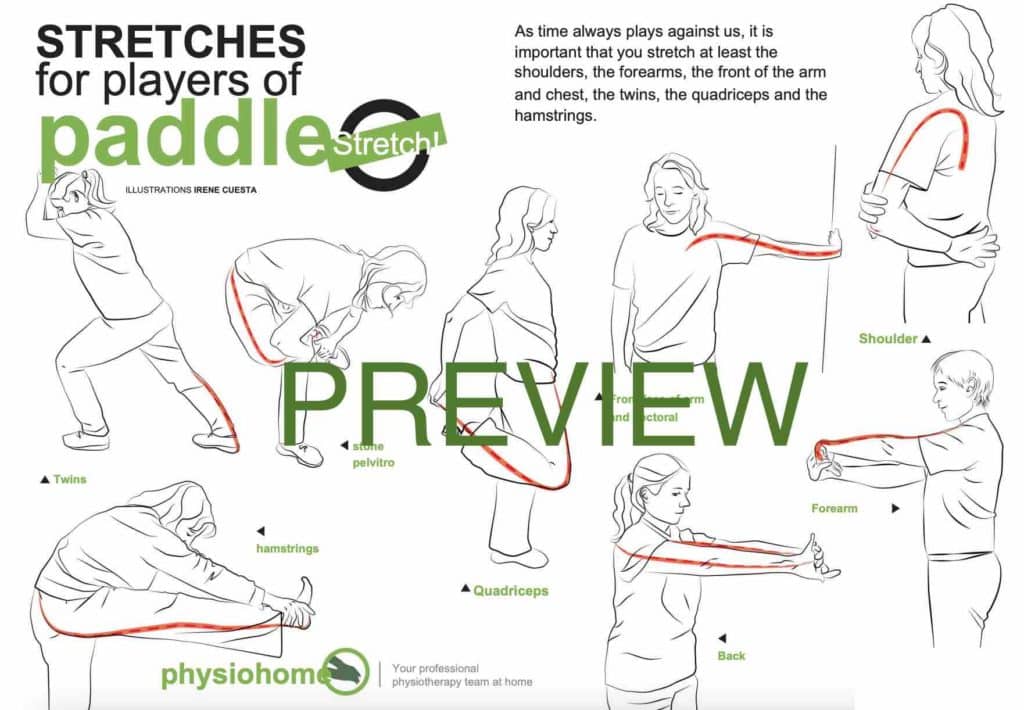
Guide source: translated version from Fisiohogar.
Frequently Asked Questions — How to warm up for padel
Yes — but use dynamic stretching (leg swings, arm circles, lateral lunges) before the match, not static stretching. Static stretching cold muscles before activity can temporarily reduce power output. Save the long static holds for your cool-down after the match.
Aim for 10 minutes of off-court dynamic warm-up followed by 10 minutes of on-court ball warm-up — 20 minutes total. If you’re short on court time, the minimum is 5 minutes of each. Anything less and you’re playing with cold muscles in a sport with genuine injury risk.
The most common injuries linked to inadequate warm-up in padel are rotator cuff strain (shoulder), lateral epicondylitis (padel elbow), ankle sprains from lateral movement, and lower back strain. All of these are significantly more likely when muscles and tendons are cold and underactivated before play.
Absolutely. Do your full off-court dynamic warm-up solo — leg swings, hip circles, arm circles, lateral lunges, high knees, torso twists. You can also hit the ball against the back glass wall on your own to start the on-court phase. By the time your partner arrives, you’ll be warm and ready to go straight into structured rallying.
Yes — especially if you play multiple times per week or are over 35. A 5-8 minute cool-down with static stretches (hip flexors, calves, shoulder, forearm) and a short walk dramatically reduces muscle soreness the next day and prevents the tendon tightness that leads to overuse injuries over time.

Lucas Sánchez is the founder of SimplePadel. Born and raised in Spain, Lucas has been living in the US and UK for the last 20 years and currently calls Miami his home. While he’s never played professionally, the dream is still alive.
Lucas loves nothing more than playing (and talking) about padel, and he considers himself lucky to have a wife and family that share his love for the game.
5 replies on “How to warm up for Padel (Beginner’s Guide)”
[…] The best way for padel players to avoid the risk of injuries, especially in the lower limbs like the knee, legs, and foot, is to warm up thoroughly. […]
[…] How to warm up for Padel […]
[…] design: If you want to be noticed while playing padel, this racket will help you. It has been colored with bright shades of yellow, green, and blue on a […]
[…] padel tennis racket best for training to get those strong hits, could potentially also be used as a warm up racket (because of it weight) for more advanced […]
[…] up before playing padel: It’s a good idea to warm up your arm, elbow, and wrist (these tiny muscles that attach to the elbow are often overworked.) […]