
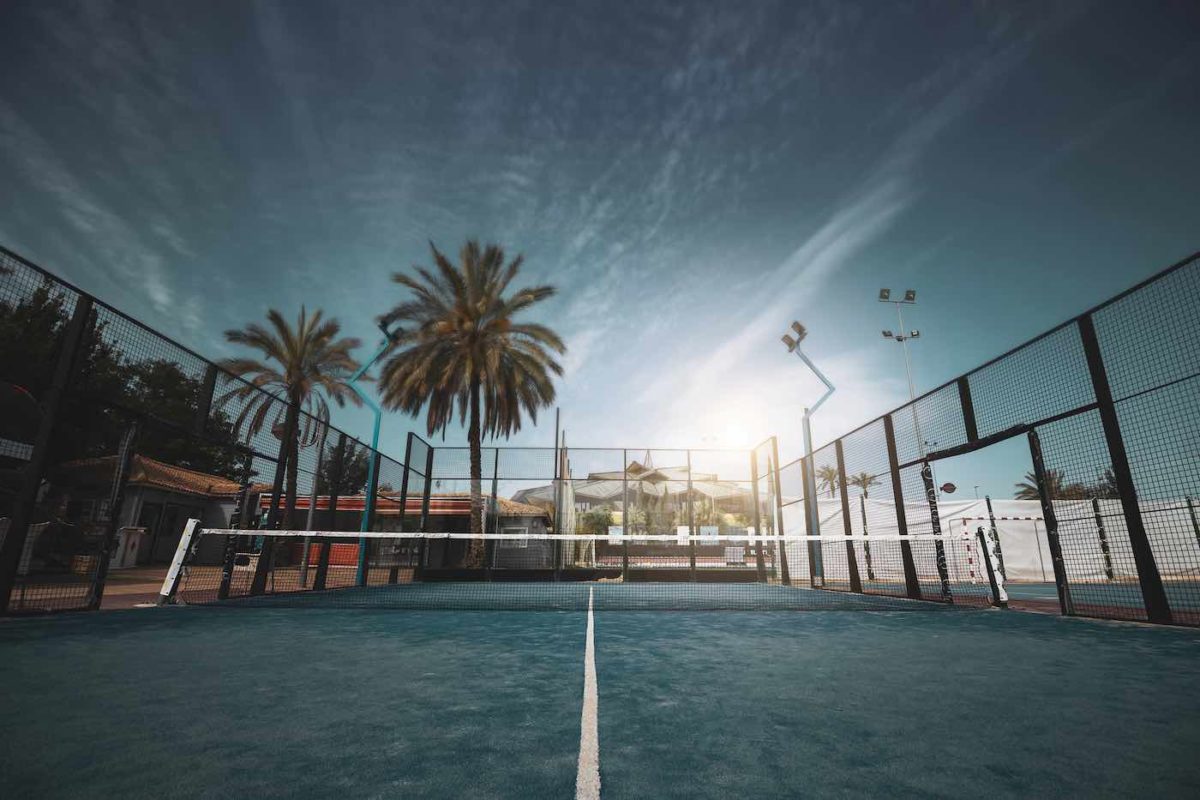
Padel is a major sport worldwide, and it has exploded in popularity across the United States since 2022. Courts are now available in most major cities, including Miami, New York, Los Angeles, Dallas, and Chicago.
Often known as padel tennis, it’s a popular social sport that individuals of all ages and skills may enjoy.
You may be unsure about the best method to follow when planning to create a padel court or start a club. This post will show you how to accomplish it one step at a time — covering everything from permits and planning approvals to choosing the right dimensions, materials, and surface, all the way through step-by-step installation and long-term maintenance.
Padel courts will almost certainly require a building permit. However, this depends on the nation and region. Before you begin, make sure to verify with your local authorities.
How Much Does It Cost to Build a Padel Court?
Among many factors that make up certain price tiers of several courts are the materials and mode of installation. If the steel structure is of high quality, it would be pricey. Costs have risen in recent years due to inflation and increased demand for padel infrastructure.
Ballpark Costs to Build Padel Court
- Premium quality – $65,000-$75,000
- High quality – $50,000-$60,000
- Median quality – $40,000-$45,000
- Lower quality – $30,000-$35,000
- Lowest quality – $25,000
Heavy glass on the back walls makes up a durable structure to play ball at any time. If you’re willing to spend on a structure that costs highly, go ahead.
But if you’re looking to build a padel tennis court at a budget range, the cost list is there to guide you.
You may even ask a professional about costs-related topics and how to get lower prices. E-mail them or call through their service lines if you must.
Different Types of Padel Courts
When building padel courts, familiarizing yourself with the materials and type is generally important. Here, you’ll learn what the padel court requires and more.
Every project has varying installation techniques and their position and other elements of the structure help decide the overall gameplay experience.
Permanent Padel Courts
Permanent padel courts are available in various forms for both indoor and outdoor usage, consisting of aluminum or steel and featuring several types of artificial turf.
The rear walls of these courts are made of frames and glass. The permanent courts’ quality varies based on the services.
The rear walls of panoramic courts, which do not have a cover, are normally 4 meters high at their tallest point.
Panoramic Padel Courts
Panorama courts, unlike normal ones, have a glass back wall that allows for excellent vision. Major competitions, like Premier Padel events, are aired on such courts.
Portable Padel Courts
Portable or non-permanent padel courts are suited for activities or contests that last only a few hours. You may use any flat, level surface to set up a movable court.
Padel Court Dimensions
The first step is to identify how much space you have and whether it is big enough to fit a padel court.
How Big Should a Padel Court Be?
For example, in two padel courts, the court is 20 meters long and 10 meters broad. The singles are 6 meters wide and the same length.
The building of covered courts is typically 8 meters tall, with a maximum height of 8.90 meters at the structure’s center point.
It is shaped like a dome or arch to maximize strength and power.
Minimum Height of a Padel Court Construction
The lob is possibly the most important element in padel tennis. Therefore having a high ceiling is key. No one wants to be penalized a point since their lob hits the ceiling.
Padel courts can be constructed outside without regard for ceiling height. Indoors, a minimum ceiling height of 7 meters is recommended, but 8 meters is much preferable.
More proficient players with increasing requirements will choose courts with higher ceilings as it develops.
How Much Space Will I Need to Build a Padel Court?
The typical courts are divided into singles and doubles. The following dimensions were set for safety reasons and are both varied for indoor use or outdoor use.
Court Length and Width – Doubles
A padel court must be 20 meters long, plus an additional 0.5 meters on each side. This brings the total area required for a double court to 231 m2.
Court Length and Width – Singles
A single court must be at least 20 meters long, plus an extra 0.5 meters. Single courts are 6 meters wide and have a length of 20 meters.
The Padel Court Construction
If you aim to build a fun padel court that has a solid surface, the price depends on the material, method of construction, maintenance, or other areas.
It pays to familiarize yourself with what you need to build a padel court with a good quality playing field.
The Glass Sections
A padel court is often built with glass walls all around, each weighing over 100 kilograms, so you must properly install the panes to avoid accidents.
Because of the higher stresses, we suggest using a tempered glass of at least 10 mm for indoor playing fields and 12 mm for outdoor fields.
Glass sections are usually 3.20 x 2.40 m in size.
A-Frame Construction
A padel court’s frame is often built of steel or aluminum.
To endure weather and temperature fluctuations, courts built for outdoor usage may have a somewhat thicker frame profile.
Before painting, the frame should be prepared and soldered. Supplier warranties vary, but in general, steel buildings are insured for 5 years and aluminum frameworks for 15 years.
Steel Mesh Sections
On the sidewalls, there are steel mesh pieces close to the glass panels. Ball contact and some players running into the mesh expose the mesh.
A genuine and long-lasting mesh is essential for maintaining game quality and decreasing injury risks.
Flooring and Surface
To achieve a very excellent sliding bounce of the tennis ball, the floor must match the parameters of hardness, speed, and roughness.
Although concrete floors may be coated with slick chemicals, artificial turf is preferable.
If the Padel Courts are to be used indoors, the flooring must be concrete and devoid of electrical, water, and gas tubes so that they may be anchored to the ground.
The Grass
Artificial grass is available in a variety of colors and styles for use on padel fields. The life expectancy of artificial grass differs, and the turf type influences the gameplay experience.
The artificial grass used on the Premier Padel tour is made by Mondo. It’s called Supercourt, and it’s available in two colors: green and blue.
It is the top pick for padel, but it is perhaps more pricey due to its outstanding quality. It has a seven-year warranty.
Basic versions work great for a padel tennis court if you don’t want to pay on the most costly synthetic turf.
The Sand
Putting them on a padel tennis court floor is quite prominent among players.
What Type of Sand Is Used on Padel Courts?
The silica sand blends in considerably better with the nanofibrous grass and, over a short period of time, produces an ideal playing surface.
Monofilament is typically more expensive and lasts longer. To create an excellent playing surface, silica sand takes considerably longer to develop into fibers.
Given the lack of upkeep on recreation areas, it is less susceptible to hardening. These treatments, though, require continuous brushing.
How Much Sand?
The textured design completely surrounds the silica sand as a stabilizer material and guarantees that the capacity remains consistent.
With this approach, the suggested silica sand filling is simply around. 7-8 kg/m2. The quantity of silica sand in standard fibrillated and monofilament solutions are 15 kg/m2.
Lighting
In a padel club, proper lighting is critical for a positive game experience.
The lighting should not distract the players, and it should be uniformly spread over the court.
You may also play in any outdoor location with the correct illumination at any time of day.
Budget and quality criteria are critical when selecting a padel club lighting system. Lighting must fulfill greater criteria if you want to broadcast television.
Your decision will impact your padel club’s game experience and profitability. Take your time to consider several choices.
Ball Stop Nets
When playing padel, a net is a simple solution to decrease the possibility of padel balls reaching the court.
If you have numerous courts nearby, these nets capture balls on their route to another court.
Ball stop nets are equally useful outside since they may keep them from being misplaced.
Permits and Planning Permission
Building a padel court almost always requires planning permission. Requirements vary by state and municipality, so check with your local authority before breaking ground. Skipping this step can result in costly fines, forced demolition, or delays that push your entire project back by months.
What Permits Do You Typically Need?
Most jurisdictions require a building permit for any permanent structure, and a padel court — with its steel frame and glass panels — firmly qualifies. Your application will typically need to include structural drawings, material specifications, and proof that the structure meets local wind and load ratings. An engineer’s stamp is often required for steel frame assemblies over a certain size.
In addition to the building permit, you will almost certainly need an electrical permit to cover the lighting installation, especially if you are running a dedicated 400+ lux LED system. If your site is changing from residential or agricultural land use to a sports or commercial facility, you may also need zoning approval before any work can begin. Where applicable, HOA approval is a further requirement — many communities have strict rules around structure heights, materials, and setbacks that a padel court can easily fall foul of if not addressed early.
Timeline for Approvals
Depending on your jurisdiction, permit approvals typically take 4–12 weeks from the date of a complete application — sometimes longer in busy municipalities or if revisions are requested. Factor this lead time into your overall project schedule so it does not hold up the construction phase. Hiring a local architect or a padel court specialist already familiar with your area’s building regulations can significantly speed up the process, since they know exactly what documentation reviewers expect and can address comments quickly.
How to Install a Padel Court?
To attain the finest results, padel court installation demands skill and understanding.
A professional installation team will typically complete a single padel court in 3–5 days, provided the site has been properly prepared in advance and all materials are on-site. Attempting to rush or cut corners at any stage can compromise structural integrity, surface quality, or long-term durability.
- Site preparation — Clear and level the ground, removing any vegetation, debris, or unstable fill. Establish a proper drainage slope of 1–2% so standing water cannot pool under the surface.
- Foundation work — Pour a concrete base with a minimum thickness of 10 cm (100 mm) and allow at least 48 hours to cure fully before loading. In colder climates, allow additional time for the concrete to reach full strength.
- Anchor installation — Drill foundation anchors into the cured concrete at specified intervals according to the frame manufacturer’s layout plan. Correct anchor positioning is critical — errors here are very difficult to correct later.
- Steel frame assembly — Erect the A-frame structure starting from the corner posts, working inward. Ensure all sections are plumb and square before tightening fasteners permanently.
- Glass panel fitting — Install tempered glass panels (10 mm for indoor courts, 12 mm for outdoor), securing each panel with rubber gaskets to absorb impact and prevent direct glass-to-frame contact.
- Steel mesh installation — Fit galvanised mesh sections on the side walls, tensioning evenly and securing at all edges to prevent sagging or warping over time.
- Surface preparation — Sweep and compact the concrete base layer thoroughly before laying artificial turf. Any debris or unevenness will show through the finished surface.
- Turf laying — Roll out the artificial grass, carefully aligning all seams. Glue or anchor edges securely to prevent lifting. Seams should run parallel to the direction of play where possible.
- Sand infill — Spread and brush silica sand evenly into the turf at the correct rate — typically 7–8 kg/m² for textured turf and up to 15 kg/m² for standard fibrillated or monofilament varieties.
- Net and lighting — String the central net to the correct tension and height (88 cm at the posts, 92 cm at the center). Install the LED lighting system at a minimum of 400 lux for recreational play, higher if broadcast use is anticipated.
- Final inspection — Test the glass panels for any chips or loose gaskets, check frame connections, verify net tension and height, and test surface evenness by walking the entire court before opening it to play.
While it is technically possible to self-install a portable or basic padel court, permanent structures should always be handled by a certified padel court installer. Working with a specialist ensures the structure meets safety standards, maintains any manufacturer warranty, and gives you recourse if issues arise post-installation.
When the job is done, check that the installer has provided you with all relevant documentation: structural sign-off, electrical certificates, material warranties, and a maintenance schedule. These documents are important both for your own records and if you ever wish to sell the property or facility.
What Type of Maintenance Will My Padel Court Require?
Padel fields require periodic upkeep. A well-kept padel court enhances both the playing surface and the court’s wear resistance.
Maintenance charges are based on the sort of court you have. Cleaning glass walls once a month and sweeping artificial grass once a week is a good rule of thumb.
This is less common with some types of artificial turf. The glass walls should be examined once a month, and you should maintain the artificial turf once a year.
What Do I Do With My Outdoor Padel Court During Winter Months?
During the winter months and wet summer days, a padel club with outdoor fields may expect decreased earnings.
Padel can and is played during the winter. Padel may be played outside in the winter if the court is dry.
In the winter, many bigger cities have indoor padel fields that are always crowded.
For a good grip on chilly court surfaces, ensure you’ve dressed appropriately and using modern padel shoes.
Frequently Asked Questions About Building Padel Courts
For questions related to this renowned social game, you may look at these FAQs below.
A padel court must be at least 20 meters long and 10 meters broad, according to the International Padel Federation (FIP).
The space required for a padel court is roughly two times that of a standard tennis court.
A padel tennis court is often built with glass walls all around, each weighing over 100 kilograms. Therefore, you must properly install the panels to avoid accidents.
Because of the high pressure, we suggest using a tempered glass of at least 10 mm for indoor courts and 12 mm for the outdoors.
Depending on the construction team, an indoor padel court building price without groundwork costs between 20,000 and 35,000 euros (roughly $22,000 to $38,000 USD).
The structure costs of the panorama sports center are somewhat more of a higher price, but they are just decorative and are not required.
Depending on the padel field and local conditions, it would require 3-5 days to create a padel tennis court.
Another important thing is that all construction work for the padel field must be performed on-site before designers arrive to install the padel fields immediately.
Final Thoughts
Playing the sport with your tennis padel rackets is truly a fun experience and eases away from the stress on your body. That’s why there’s a light feeling when on the playing surface.
Always consider, before plotting the construction project of the playing field, the distance of the play area, among other things. The floor of the building must be of superior quality.
If you want to learn how to build a padel court, learn the basics of the playing area first. Sort your permits early, choose materials suited to your climate, and work with a certified installer to ensure the finished court will last for years and deliver a great experience to every player who steps on it.

Isabella Torres is originally from Madrid, Spain, and has been playing Padel as a semi-professional for the past five years. After completing her education as a journalist, she discovered her true passion in life was writing about Padel.
She loves staying up late watching intense rallies on YouTube, and is excited to share her knowledge about the sport with SimplePadel’s readers.
2 replies on “How to Build a Padel Court”
[…] Interested in building your own court? Read our article on How to build a Padel court. […]
[…] Proper installation is vital to achieving a high-quality padel court. Engaging experienced professionals in the installation process is recommended to ensure optimal results. The installation involves various steps, including setting up the court’s structure, installing glass walls, pouring and spreading sand, and laying the artificial turf. Paying attention to the correct installation of synthetic turf is crucial for a successful outcome, and experts should always carry it out. […]