
Padel and squash both use walls, but they are very different sports. Padel is a doubles game played with a stringless racket and a tennis-like ball on an enclosed glass court the size of a small tennis court. Squash is usually singles, played with a thin strung racket and a small, soft rubber ball inside a tighter four-walled box. The shared “walls are in play” idea is where the similarity ends.
If you come from squash, padel will feel familiar in some ways and alien in others. This guide covers every difference that matters, the court, the racket, the ball, scoring, gameplay, and fitness, so you know exactly what to expect.
Coming to padel from squash? You will need a padel-specific racket and balls. See our picks for the best padel rackets for beginners and the best padel balls, or start with a forgiving all-rounder like the Wilson Carbon Force Team.
Padel vs Squash: At a Glance
| Feature | Padel | Squash |
|---|---|---|
| Court | 66 x 33 ft, glass + mesh, outdoor or indoor | 32 x 21 ft, four solid walls, indoor |
| Format | Almost always doubles | Usually singles |
| Racket | Stringless, solid, perforated | Thin, strung, long-handled |
| Ball | Tennis-like, low pressure | Small, soft, hollow rubber |
| Walls in play | Yes (after the bounce) | Yes (front wall must be hit) |
| Scoring | Tennis scoring (15/30/40) | Point-a-rally to 11 |
| Serve | Underhand, bounce first | Hit to the front wall |
| Intensity | High, sustained | Very high, explosive |
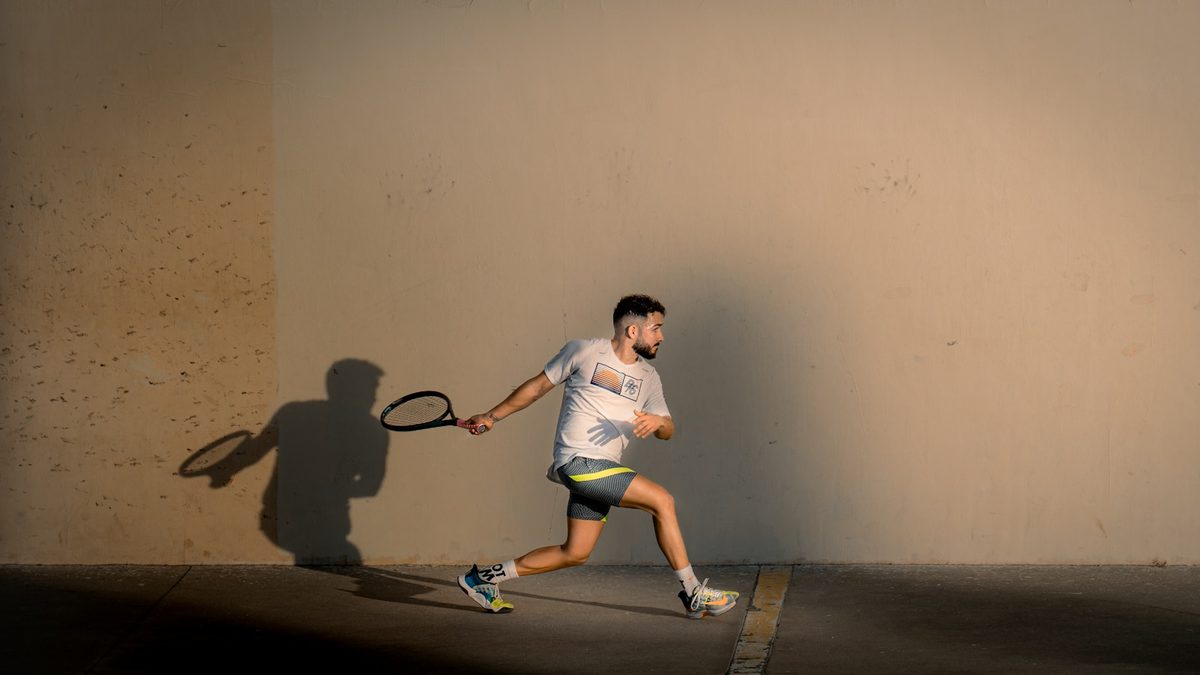
Both sports keep the ball alive off the walls, which is why squash players often take to padel quickly. But the way the walls work is different. In squash, you must hit the front wall on every shot, and the side and back walls are used to angle your shots. In padel, you hit the ball over a net like tennis, and the walls only come into play after the ball has bounced on the floor, you can let it rebound off the back glass and play it on the way out. So squash is wall-first; padel is net-first with walls as a recovery tool.
The Court
A padel court is 66 x 33 ft (20 x 10 m), enclosed by glass and metal mesh, and split by a net, roughly a third the size of a tennis court and built for two-a-side. A squash court is much smaller and tighter at about 32 x 21 ft (9.75 x 6.4 m), fully enclosed by four solid plaster or panel walls with a front-wall tin and service lines, and it is an indoor-only, single-room sport. Padel courts are usually clustered at racket clubs; you will find squash courts in many gyms and leisure centres.
Equipment: Racket and Ball
A padel racket is solid and stringless with a foam core, perforated face, and a wrist strap, weighing 360 to 385g. A squash racket is the opposite: light (110 to 170g), thin, strung, with a long handle and small head, much closer to a tennis racket in construction. The balls could not be more different either: a padel ball is a slightly depressurised tennis ball, while a squash ball is a small, soft, hollow rubber ball that only bounces once warmed up. If you are gearing up for padel, see our best beginner padel rackets.
Scoring and Gameplay
Padel uses tennis scoring (15, 30, 40, games and sets) and is a doubles game of long, tactical rallies built around the net and the lob. Squash is typically point-a-rally to 11 (win by 2), played as a fast singles duel where you and your opponent share the same space and take turns hitting the front wall. Padel rewards positioning and patience; squash rewards explosive movement and shot precision in a confined box.
Which Is a Harder Workout?
Both are demanding, but squash is famously one of the most intense racket sports going, short, explosive sprints and constant direction changes in a small space spike your heart rate fast. Padel is also a serious workout thanks to long rallies and court coverage, but it is lower-impact and more social, which is part of its broad appeal. If you want maximum calorie burn in the shortest time, squash wins; if you want a sustained, sociable, easier-on-the-joints game, padel does.
Which Should You Play?
- Play padel if you want a social doubles game, longer rallies, and a gentler impact on the body.
- Play squash if you want an intense solo workout and a faster, more explosive game.
- Coming from squash? Your wall instincts and footwork transfer well, padel will click quickly.
Comparing padel to other racket sports? See padel vs pickleball, padel vs tennis and padel vs paddleball, and our three-way padel vs pickleball vs paddle tennis breakdown.
Frequently Asked Questions About Padel vs Squash
They share the idea of playing the ball off the walls, but they are different sports. Padel is a net-based doubles game with a tennis-like ball on a glass court, where the walls only come in after the bounce. Squash is a singles game where you hit a small rubber ball directly against the front wall.
In squash you must hit the front wall on every shot and play is wall-first. In padel you hit over a net like tennis and use the walls only after the ball bounces. Padel is doubles with a stringless racket; squash is usually singles with a thin strung racket.
Squash is one of the most intense racket-sport workouts, with explosive sprints in a small court. Padel is also demanding but lower-impact and more social. Squash burns more in less time; padel is easier on the joints.
Yes, and they often pick it up fast. The wall instincts and quick footwork transfer well, though squash players have to adjust to hitting over a net and to padel being a doubles, position-based game.
New to the sport? Start with what is padel and how to play padel, then find a court in our guide to padel in the US.

Lucas Sánchez is the founder of SimplePadel. Born and raised in Spain, Lucas has been living in the US and UK for the last 20 years and currently calls Miami his home. While he’s never played professionally, the dream is still alive.
Lucas loves nothing more than playing (and talking) about padel, and he considers himself lucky to have a wife and family that share his love for the game.