A padel Americano is the fastest way to get a group of players on court, mix partners every round, and crown an individual winner at the end. It’s the format US clubs reach for when 8, 12, or 16 players want a social tournament that runs in a couple of hours rather than a full day.
A padel Americano is a rotating-partner tournament format where every point counts toward your individual total. Instead of fixed doubles teams, you switch partners each round until you’ve played alongside everyone in the group. The player with the most total points at the end wins, regardless of who they were paired with.
This guide walks through how an Americano tournament actually works, the scoring system, the most common variations (Mexicano, Mixed Americano, Team Americano), how to organize one at your club, and the best apps for running it. Our guide on how to play padel covers the basics if you’re brand new to the sport.
Padel Americano at a Glance
| Feature | Padel Americano | Standard Padel Match |
|---|---|---|
| Teams | Rotate every round | Fixed doubles pair |
| Scoring | Every rally = 1 point | 15 / 30 / 40 / game / set |
| Winner | Individual with most total points | Team that wins the sets |
| Ideal group size | 8 to 16 players (multiples of 4) | 4 players |
| Duration | Around 2 hours for 8 players | 60 to 90 minutes per match |
| Best for | Club nights, social mix-ins, charity events | Regular league / competition play |
What is an Americano in Padel?
An Americano is a padel tournament format built around rotating partners and cumulative individual scoring. Padel itself is always played as doubles, but in an Americano you switch partners after every round until you’ve paired with every other player at least once.
The format became popular in Scandinavia and Spain as a way to run quick, sociable club tournaments. It’s now one of the most common tournament formats at US padel clubs too, because it works with awkward player counts (8, 12, 16), produces a clear individual winner, and keeps every rally meaningful.
By the end of the event, you’ll have played with every other participant and (depending on the exact format) against most of them as well.
How to Play Americano Padel
How many players do you need?
Padel is a doubles sport, so an Americano needs a player count that’s divisible by four. Common group sizes are 8, 12, or 16 players. With 8 players on 2 courts, you’ll play a 7-round tournament where everyone pairs with everyone else exactly once.
How long does an Americano tournament last?
The length depends on the number of players, the number of points per match, and whether you use a hard time cap. As a rough guide:
- 8 players, 2 courts, 24 points per round: around 2 hours.
- 12 players, 3 courts, 24 points per round: around 2.5 hours.
- 16 players, 4 courts, 32 points per round: around 3 hours.
Most clubs also set a hard time limit per round (for example, 12 minutes) to keep the event moving. If the round hits the time cap, whichever team is ahead at that point wins the round.
The scoring system
Americano scoring is different from standard padel scoring. There’s no “15, 30, 40, game” – every rally is worth one point, and the total accumulates across the whole tournament.
Points-based scoring
Each round is played to a fixed number of points (commonly 24 or 32). Serves typically rotate every four points. A round might end 18-14 – the two winners each add 18 to their personal total, and the two losers each add 14.
This is the most common Americano format because it keeps every ball meaningful. A player on a losing team can still rack up serious points if their rallies go deep.
Sets-based scoring
A less common variation plays each round as a short set (for example, first to 4 games). The team total is tracked across the tournament, but individual rally counts don’t matter. This feels closer to a normal padel match and is a good middle-ground format if your group finds pure rally-counting too chaotic.
Who wins the Americano?
The individual with the highest point total at the end wins the tournament. Your partners rotate every round, so you’re essentially on your own to rack up points. That’s one of the reasons Americanos feel so competitive – even if your current partner is struggling, your personal total is still on the line.
How many courts do you need?
Courts match the number of players divided by four. 8 players = 2 courts. 12 players = 3 courts. 16 players = 4 courts. If your club only has one court, you can still run an Americano, but players will sit out in rotation, which lengthens the event.
Padel Americano Variations
There are a handful of common Americano-style formats. The differences mostly come down to how partners are drawn and how points are counted.
Normal Americano
Every player plays with every other player at least once. Partners rotate according to a fixed schedule (an app or a printed sheet tells you where to go each round). Scoring is points-based and individual.
Mixed Americano
Every team has one male and one female player. The tournament runs until every woman has played alongside every man at least once. Mixed Americanos are especially popular for club socials and charity events because they encourage pairings across the membership.
Team Americano
Players stay with their original partner for the entire event, but each team still plays every other team at least once. Scoring is based on team points. This is the closest format to a standard padel match and a good option if you have fixed partners who don’t want to split up.
Mexicano
Mexicano is the most competitive Americano variant. After the first round, the app or schedule ranks players by their current points total. The top two players on the leaderboard pair up and play the third- and fourth-placed players, and so on. Pairings change every round based on current standings.
Because the pairings shuffle toward similarly-ranked players, matches tend to stay close. Mexicano is what most competitive club nights end up running.
Team Mexicano
Same rules as Mexicano, but with fixed teams. Teams get re-matched each round based on standings. Best for groups of regular doubles pairs who want a competitive mini-league feel.
Super Mexicano
A Mexicano twist where players on the “leader court” can earn extra points per rally. Bigger risk, bigger reward. You rise (or fall) through the courts faster. Super Mexicano isn’t for everyone – it rewards aggressive play and punishes safe play. Most casual groups stick with standard Mexicano.
Best Apps to Run a Padel Americano
Running an Americano manually (printed schedule, pen, paper) is painful once you have more than 8 players. These are the apps US clubs and organizers use most often. All of them handle the pairing logic automatically – you enter names, number of courts, and points per round, and the app does the rest.
1. Americano Padel
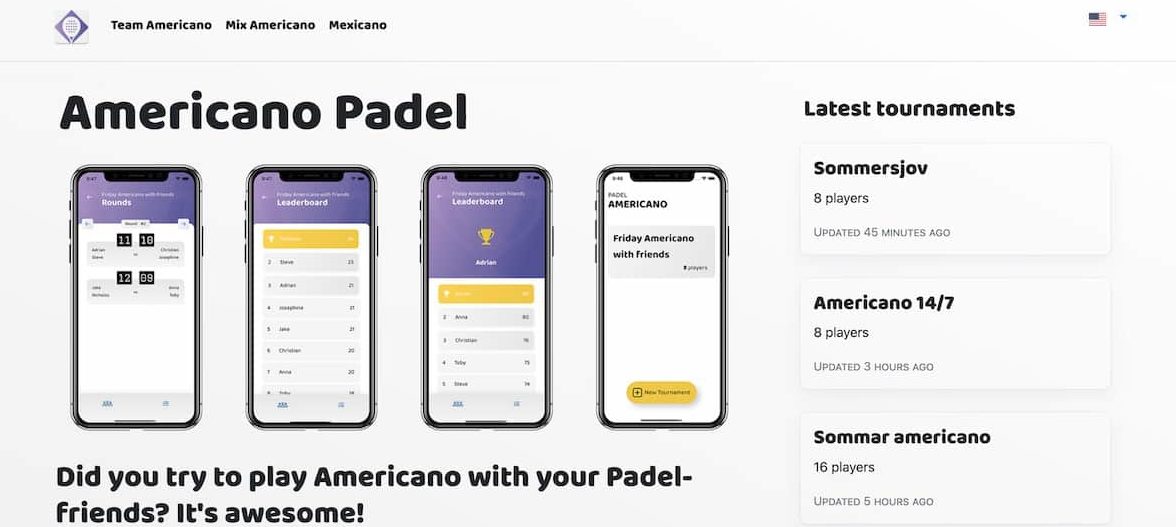
Purpose-built for Americano and Mexicano formats. Available on Android and iOS for a small fee. Clean interface and big touch targets, which matters when you’re updating scores mid-round on a tablet.
Before the tournament, enter player names, number of courts, and points per round. After each round you just type in the score and the app handles pairings, leaderboards, and schedules.
Pros
- Interactive leaderboard
- Supports most Americano and Mexicano variants
Cons
- Subscription needed for multi-court events
- Paid on iOS
Download Americano Padel


2. Padel Puffin
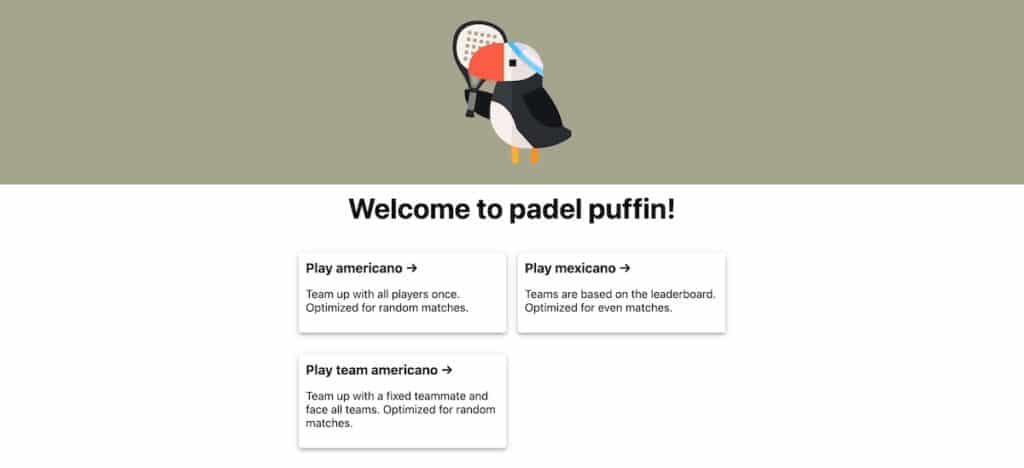
Browser-based and free. No app install, no account. Good for one-off events or casual club nights where you don’t want to commit to a paid tool.
Pick your format, enter team names and points per match, and the site handles rotation and scoring. It uses a points slider to log scores, so the barrier to data entry is low.
Pros
- Free to use
- Runs on any device with a browser
Cons
- Fewer format options than the native apps
- No native mobile app
3. Padelboard

Built by MATCHi, the club-booking platform. Free on iOS. Players can join via a tournament ID or QR code, which makes on-boarding fast when you have 16 players arriving at slightly different times.
Worth noting: parts of the app are still more polished in Swedish than English, so run a test event before committing to it for a big US club tournament.
Pros
- Join via tournament ID or QR code
- Confirms event details before locking in
Cons
- Some parts still Swedish-only
- No Super Mexicano or Mixed Americano option
- iOS only
Download Padelboard by MATCHi
4. Rankedin

More than an Americano tool. Rankedin handles full tournament management for racket sports, including live scoring, live scoreboards, streaming integrations, and player rankings. If your club runs tournaments year-round, it’s the most complete option.
- Live streaming support
- Live scoring and scoreboards
- Tournament brackets and Americanos
- Player ranking system
Download Rankedin
How to Organize a Padel Americano at Your Club
If you’re running your first Americano, here’s the checklist most US club organizers use.
- Lock in your player count. Aim for a multiple of 4. Over-recruit slightly – expect 10 to 15 percent no-shows for casual club events.
- Book the right number of courts. One court per four players for the smoothest experience.
- Pick the format. Normal Americano for social events, Mexicano for competitive nights, Mixed Americano for charity or club-mix evenings.
- Decide points per round. 24 points is the US club default. Drop to 16 if you want faster rounds, increase to 32 for longer, higher-stakes matches.
- Set a hard time cap. 10 to 15 minutes per round keeps the event running on schedule.
- Pick your app. See the options above. Test it with 4 people before the real event.
- Brief players at the start. Walk through scoring, rotation, and what to do at each round break.
- Have someone on scoreboard duty. Ideally a non-player. If everyone is playing, rotate the responsibility.
- Finish with a leaderboard reveal. Announce top three – it’s a tournament, not a drill, and the social payoff matters.
If you’re new to the sport and want a refresher before your first Americano, our guide on how to play padel and our serving rules guide are good starting points.
Frequently Asked Questions about Padel Americano
A padel Americano is a rotating-partner tournament format where every rally counts as one point toward your individual total. Players switch partners every round until they’ve played with everyone in the group. The player with the highest total points at the end wins, regardless of who they were paired with.
Most US clubs play rounds to either 24 or 32 points. 24 keeps rounds fast (around 12 minutes). 32 gives longer, more tactical rounds. The exact number is agreed before the event starts and stays the same across all rounds.
In a normal Americano, partners rotate according to a fixed schedule so everyone pairs with everyone else exactly once. In a Mexicano, pairings are dynamic: after each round, the app re-pairs players based on their current leaderboard position. Mexicanos produce tighter matches because you end up playing with and against players of similar standing.
You need a number that’s divisible by four. The most common group sizes are 8, 12, and 16. With 8 players and 2 courts, the event takes about 2 hours. With 16 players and 4 courts, expect closer to 3 hours.
Yes. Because every round is played to a fixed number of points, a round can end with a tied score (for example, 16-16 in a 32-point round). Across the whole tournament, the overall leaderboard can also end in a tie; most clubs break ties using total rallies won or head-to-head results.
Yes. Americano and Mexicano formats are the default tournament structure for most US club nights and social events, especially at clubs in Florida, California, New York, and Texas where padel has grown fastest. The format works well for clubs with irregular player counts and mixed skill levels.
Ready to Run Your First Americano?
Rally your padel friends, lock in your courts, pick an app, and agree on points per round. The format is forgiving – even if the first event is a little rough, everyone will have played with new partners, burned through four or five matches, and left with a number next to their name.
For related reading, see our guides on how to play padel, padel serving rules, and padel tips for beginners.

Lucas Sánchez is the founder of SimplePadel. Born and raised in Spain, Lucas has been living in the US and UK for the last 20 years and currently calls Miami his home. While he’s never played professionally, the dream is still alive.
Lucas loves nothing more than playing (and talking) about padel, and he considers himself lucky to have a wife and family that share his love for the game.
4 replies on “Padel Americano: How to Play, Scoring Rules & Best Apps”
[…] club hosts an Official Pepper Padel Tournament every 2 months as well as smaller formats such as Americanos which are held […]
[…] Padel continues to be on the rise in the US. Pennsylvania is no exception. PADELphia with their two locations and total of five state-of-the-art courts are by far your best “padel first experience” if you wish to play a casual game of padel with friends or drop in to a tournament. […]
[…] provide on-site trainings as well as events and tournaments. Their facility consists of 2 outdoor courts with the latest in court technology. They’re […]
[…] Americano: A rotating partner format where every player partners with every other player across a series of short sets. Great for socialising and getting a competitive feel. Learn how an Americano works. […]