Most Common Padel Injuries: Prevention, Recovery & When to See a Doctor

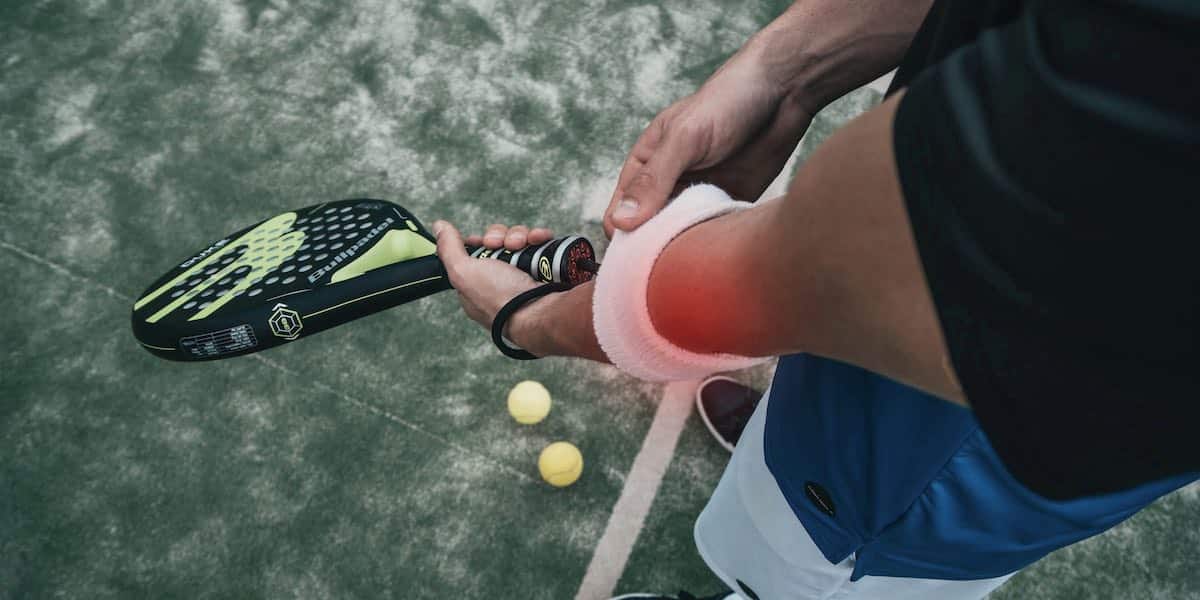
Padel is easier on the body than tennis, but it’s not injury-free. The rapid changes of direction, the walls forcing awkward body positions, and the volume of overhead shots all take a toll over time. Most padel injuries are preventable with warm-ups, proper technique, and the right gear – but the common ones still come up at every club.

The most common padel injuries are ankle sprains, tennis elbow (“padel elbow”), shoulder strains (especially from smashes and bandeja shots), knee injuries, lower back strain, and calf strains. Most are caused by poor warm-up, bad technique, or worn-out equipment (especially shoes). The good news is they’re almost all preventable with a proper 10-minute warm-up, decent padel shoes with a fishbone sole, and taking time to learn good shot mechanics.

This guide covers the seven most common padel injuries, their symptoms, how to prevent each one, realistic recovery timelines, and when you should see a doctor rather than keep playing through it.

Golden Point in Padel: The Sudden-Death Rule Explained

Traditional padel scoring, like tennis, can drag a deuce game out for minutes – repeatedly going from 40-40 to advantage and back. In 2020, the World Padel Tour introduced a rule that put an end to that: the gold point. One point at 40-40 decides the game. No advantage, no repeat deuces, just sudden death.

The gold point (punto de oro, also called the golden point) is a sudden-death scoring rule in padel. When the score reaches 40-40 (deuce), there is no advantage play. The next point wins the game. The receiving team chooses which side of the court to receive on, and whoever wins that single point takes the game. The rule was introduced by the World Padel Tour in 2020, adopted by the International Padel Federation shortly after, and is now used across most professional tours including Premier Padel.

This guide covers exactly how the gold point rule works, who benefits from it, why professionals were divided when it was introduced, and when it’s used in amateur play. It also covers the newer “bronze point” and “silver point” variations some tours have experimented with.

Padel Serve Rules: Complete Guide to Serving in Padel

The serve is the one shot in padel you always start a point with, and the one beginners get wrong most often. Unlike tennis, a padel serve has to be underarm, below the waist, bouncing off the floor first, and landing diagonally in the opponent’s service box. If any of those conditions slip, the serve is a fault.

A legal padel serve is hit underarm, struck below the waist (at or below 1.06 m from the ground under current FIP rules), after letting the ball bounce once on the server’s side of the court, and landed diagonally in the opponent’s service box on the first bounce. The server stands behind the service line, with at least one foot on the ground, and must not step on or over the line before contact. Each server gets two attempts per point. A ball that touches the net and lands in the service box is a let and is replayed.

This guide covers every padel serve rule you need to know: how to stand, what counts as a fault, when a let is called, how the tie-break rotation works, and the 2024 FIP rule changes that clarified the serve height. It also explains the two most common serve variations (underarm and backhand) and the foot-fault situations that catch every new player out.

10 Padel Tips for Beginners: How to Win More Points

Padel is easy to pick up and brutal to master. The scoring is the same as tennis, the court is smaller, the walls are in play, and the paddle feels nothing like a tennis racket. If you’ve just started and you’re losing more points than you’d like, the good news is that most beginner mistakes are fixable with a handful of deliberate adjustments.

The fastest way to win more points in padel as a beginner is to cut unforced errors, play the lob and the wall rebound, stay with your partner, and forget about power. Consistency wins at the club level – not smashes.

This guide is a set of padel tips and strategies that actually move the needle if you’re new to the sport. We’ll cover positioning, the must-learn shots, the beginner mistakes that cost most points, and how to build a basic game plan that wins against players at your level. If you’ve never played before, start with our guide on how to play padel.

Padel Americano: How to Play, Scoring Rules & Best Apps

A padel Americano is the fastest way to get a group of players on court, mix partners every round, and crown an individual winner at the end. It’s the format US clubs reach for when 8, 12, or 16 players want a social tournament that runs in a couple of hours rather than a full day.

A padel Americano is a rotating-partner tournament format where every point counts toward your individual total. Instead of fixed doubles teams, you switch partners each round until you’ve played alongside everyone in the group. The player with the most total points at the end wins, regardless of who they were paired with.

This guide walks through how an Americano tournament actually works, the scoring system, the most common variations (Mexicano, Mixed Americano, Team Americano), how to organize one at your club, and the best apps for running it. Our guide on how to play padel covers the basics if you’re brand new to the sport.

How to Play Padel: A Complete Beginner’s Guide (Rules, Scoring & Tips)

Padel is one of the fastest-growing sports in the United States right now — and if you’ve never played before, you’re in the right place. Originally invented in Mexico in 1969, padel has exploded globally and is now reaching every corner of the US, from California to Florida to New York.

This guide covers everything a complete beginner needs to know: the rules, the court, the equipment, and how scoring works. By the end, you’ll be ready to step on the court with confidence.

Padel vs. Pickleball vs. Paddle Tennis: What’s the Difference?

Padel, pickleball, and paddle tennis are three racket sports that have exploded in popularity across the US — but they play very differently. Padel has grown from a niche sport to a mainstream game with thousands of courts and a professional league in the US, while pickleball has been the fastest-growing sport in the country for several years running. On the surface they look similar, but once you step on the court the differences are obvious.

Padel Pickleball Paddle Tennis
Court size 65.6 ft × 32.8 ft (enclosed) 44 ft × 20 ft (open) 60 ft × 27 ft (open)
Walls Yes — glass & mesh walls in play No No
Ball Pressurised rubber ball Perforated plastic (wiffle-style) Depressurised rubber ball
Racket Solid foam/carbon paddle, no strings Solid composite paddle Solid perforated paddle
Scoring Tennis scoring (games, sets) First to 11 points Tennis scoring
Doubles? Always played in doubles Singles or doubles Singles or doubles
Serve type Underarm only Underarm only Underarm only
US popularity Fast growing — 1,000s of courts Fastest growing sport in the US Niche, primarily East/West Coast

Other similar sports that use racquets and tennis balls include Padel Ball, Beach Tennis, Squash, etc.

Breaking Down the Best Padel Balls: A Complete Guide and Reviews for All Levels

Padel is one of the fastest-growing sports in the United States. A variant of tennis, padel is played on a smaller enclosed court with walls, using balls that look like tennis balls but have lower internal pressure. And as more courts open across the country, more players are asking the same question: which padel balls should I actually buy?

With padel clubs now operating in states from California to Florida to New York, the range of padel balls available on Amazon and in specialty sports stores has expanded considerably. Not all balls play the same, and choosing the wrong one for your level can genuinely hurt your development.

This wide variety of options has padel enthusiasts scratching their heads. Which padel balls should they choose? Which are the best if you play with a lot of spin?

Let’s go through some of the best padel balls on the market in 2026. We’ll cover how padel balls are made, how much they cost, and which ones will give you the right feel for your skill level.

How to Build a Padel Court

Padel is a major sport worldwide, and it has exploded in popularity across the United States since 2022. Courts are now available in most major cities, including Miami, New York, Los Angeles, Dallas, and Chicago.

Often known as padel tennis, it’s a popular social sport that individuals of all ages and skills may enjoy.

You may be unsure about the best method to follow when planning to create a padel court or start a club. This post will show you how to accomplish it one step at a time.

Padel courts will almost certainly require a building permit. However, this depends on the nation and region. Before you begin, make sure to verify with your local authorities.

Kids Padel: Get them to share your interest in playing Padel

Padel is a competitive sport that helps children learn a new skill, gain confidence and make friends on and off the court.

It brings many benefits like physical coordination and balance and is a fun activity that can boost self-esteem. The question is, what is the best age to introduce children to the sport?

Let’s look go over the basics and benefits of playing Padel. We’ll look at how to find your local padel court, how to motivate children and get them into sports, and the Padel rules for beginners.