
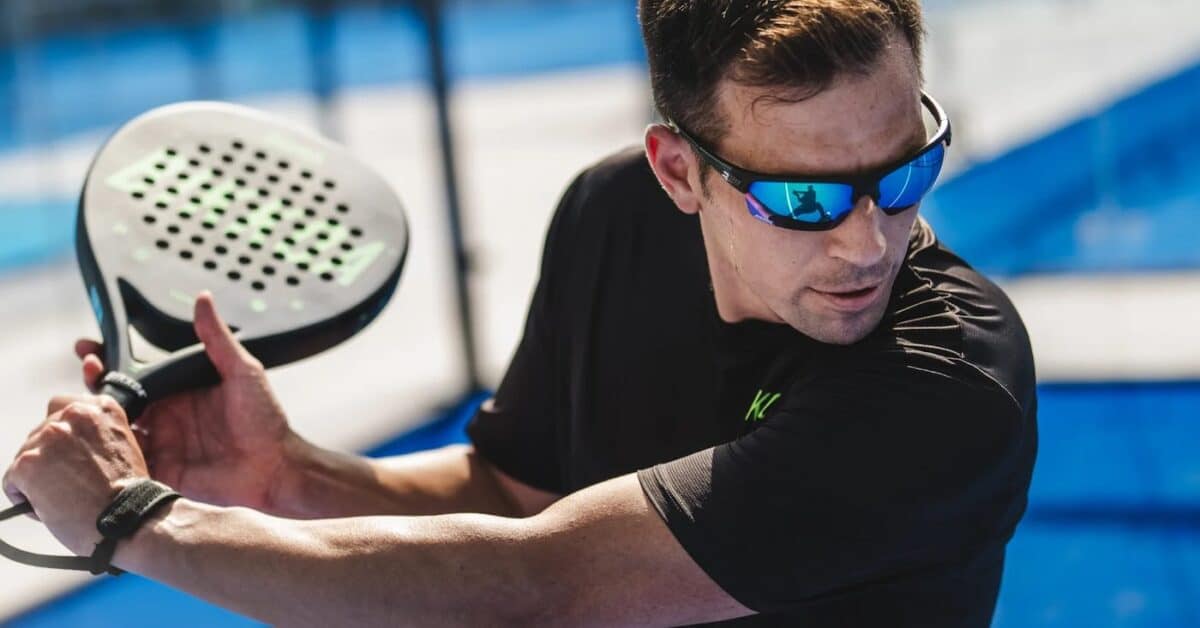
Padel eyewear splits into two genuinely different products: impact-rated protective glasses for the ball, and tinted sunglasses for glare on outdoor courts. They solve different problems, they are built differently, and the pair that suits a sunny outdoor session is usually the wrong choice for an indoor club.
Eye protection is also the piece of padel kit almost nobody buys until something happens. That is worth reconsidering, because the injury data is more pointed than most players expect.
Do You Actually Need Eye Protection for Padel?
A 2026 survey of padel players published in Eye put some numbers on this. Of the players surveyed, 10.3% reported having sustained at least one eye injury while playing, and of those injuries 92% were caused by ball impact. Padel is played inside an enclosed court with a ball that rebounds off glass at close range, often with your partner swinging behind you, so that is not a surprising result.
The severity range is wide. At the mild end sit surface problems like keratitis from sun exposure and corneal erosion from a ball graze. At the serious end the same survey and the wider literature record retinal detachment, posterior vitreous detachment, dislocated lenses and fractures to the orbital bone around the eye.
Two things follow from that, and they pull in opposite directions. The risk is real and concentrated in ball impact. But adoption is very low: in the same survey only about one player in ten strongly endorsed routine use of protective goggles, and roughly a third gave the idea little or no support. The International Padel Federation does not require protective eyewear, so there is no rule nudging anyone either.
The honest read is that this is a personal risk call rather than a settled question. If you play a lot of doubles at the net, wear contact lenses, or have had eye surgery, the case is much stronger than it is for an occasional social player. For where eye injuries sit alongside the rest, see our guide to the most common padel injuries.
Two Different Products, Two Different Jobs
| Protective glasses | Padel sunglasses | |
|---|---|---|
| Solves | Ball and racket impact | Glare, low sun, UV |
| Lens | Impact-rated polycarbonate or Trivex | Tinted, often photochromic |
| Tint | Usually clear | Contrast tint, category 1–3 |
| Where | Indoor and outdoor | Outdoor courts only |
| Coverage | Wraparound, closed sides | Wraparound, ventilated |
| Buy it if | You want genuine impact protection | Low sun is costing you points |
Some models try to do both, and photochromic lenses in an impact-rated frame are the closest thing to a single answer. That combination is what most padel-specific eyewear aims at.
What to Look for in Padel Eye Protection
Lens material
Polycarbonate or Trivex. Both are impact-resistant in a way that standard plastic and glass lenses are not, which is the entire point for a sport where the hazard is a ball at speed. Trivex is optically slightly clearer and lighter; polycarbonate is more common and cheaper. Either is fine, and anything else is not really protective eyewear.
Frame material and fit
TR90 is the frame material worth knowing. It is a flexible nylon composite that takes an impact and returns to shape rather than snapping, and it is light enough to forget you are wearing it. A wraparound shape matters as much as the material, because a ball in padel can arrive from the side or from behind off the glass, not just from in front.
Photochromic lenses
Photochromic lenses darken in response to UV, so one pair can run from a dim indoor club to bright outdoor sun. Good padel-oriented models shift across roughly category 1 to category 3, which is genuinely useful if you play both settings. The trade-off is that they react to UV rather than to visible light, so behind glass or under some indoor lighting they may not darken as you expect.
Ventilation and fogging
Padel is played in short intense bursts, often indoors, and a fogged lens is worse than no lens. Look for vented frames and an anti-fog coating. This is the single most common reason people buy protective eyewear, wear it twice, and abandon it.
Sunglasses for Outdoor Padel, and Why Polarized Is the Wrong Choice
This is the counter-intuitive one. Polarized lenses are excellent for driving and fishing because they kill horizontal glare, and they are a poor choice for padel.
Two reasons. Polarization can reduce the contrast that helps you pick a fast-moving yellow ball out of the background, and it interacts oddly with the glass walls and any wet patches on the court surface, which is exactly the visual information you need. For racket sports the advice from lens makers is consistent: choose a contrast-enhancing non-polarized tint rather than a polarized one.
What to look for instead: a tint that lifts contrast in the yellow-green range, category 2 to 3 darkness for real sun, a wraparound fit that stays put when you sprint, and grippy nose and temple pads. Low winter sun on an outdoor court is arguably a bigger problem than midsummer glare, because the sun sits directly in the line of a lob.
Indoor Courts, Outdoor Courts
Indoors, glare is not the issue and impact is, so a clear impact-rated lens is the sensible choice. Outdoors you are managing both, which is where photochromic impact-rated glasses earn their price, or where players simply keep two pairs.
If you mostly play indoors and only want one pair, buy for impact and ignore tint. If you mostly play outdoors in strong sun, buy for glare and treat the impact rating as a bonus. Trying to split the difference on a budget usually produces a pair that does neither job well.
Prescription Glasses and Contact Lenses
Everyday prescription glasses are a poor fit for padel. The lenses are usually not impact-rated, the frames are not built to stay on during a sprint, and a broken frame near the eye is its own hazard. The options are prescription sports eyewear, which several specialist makers produce for racket sports, or contact lenses under protective glasses.
Contact lens wearers have a specific reason to consider eye protection: a ball impact or even a gust of court dust with a lens in place is more likely to cause a corneal problem. If you wear lenses and play regularly, this is probably the strongest single argument for buying a pair.
A Note on What You Can Actually Buy
Padel-specific eyewear is a young category. Several brands build dedicated padel ranges, and a number of the better-known racket-sport and cycling eyewear makers now market lines aimed at padel and pickleball, which are effectively the same visual problem. The practical difficulty for players in the United States is that the padel-native specialists are largely European, while the widely stocked options are the crossover racket-sport ranges.
That is not a real drawback. The specification is what matters, and an impact-rated polycarbonate or Trivex lens in a vented TR90 wraparound frame does the same job whatever the badge on the temple says. Buy to the spec list above rather than to the category label. If you are still assembling a first kit, our padel equipment guide covers what you genuinely need before this, and the rest of our padel accessories coverage sits alongside it.
Padel Eyewear Reviews and Tests
In a hurry? For impact protection indoors, the HEAD Impulse is the straightforward pick. If you want one pair that handles both indoor and bright outdoor sessions, the Python RG Multi Lense swaps lenses. And if you already wear glasses, the Python Overglasses fits straight over them.
These are grouped by the job you need doing, because as covered above there is no single pair that is best at everything. Note that all five are racket-sport designs rather than padel-badged ones, which is the practical reality of buying this category in the US and makes no difference to the specification.
Best overall protection: HEAD Impulse Racquetball & Squash Goggles
- Shatter-proof polycarbonate lens, the impact-rated material you want.
- Anti-fog and scratch-resistant treatment, which is what keeps them on your face after week two.
- Adjustable strap rather than temples, so they stay put during a scramble.
- Built for high-speed ball contact in an enclosed court, which is exactly the padel hazard.
This is the sensible default if your reason for buying is the ball rather than the sun. It is a goggle rather than a sunglass, so it is an indoor-first choice, and the strap fit means it will not shift when you turn for an overhead. If you already own racquetball goggles, our comparison of padel vs racquetball explains how the two sports differ.
Best for indoor and outdoor: Python RG Multi Lense Eye Protection
- Interchangeable lenses, so one frame covers a dim indoor club and bright outdoor sun.
- Impact-rated construction in the racquetball and squash tradition.
- Supplied with a case, which matters more than it sounds for a swappable-lens set.
- The closest thing here to a single-purchase answer.
If you split your play between indoor and outdoor courts, this solves the problem that a fixed tint cannot. Swapping a lens takes a few seconds and avoids either squinting outdoors or playing through an unnecessarily dark lens indoors.
Best if you wear prescription glasses: Python Overglasses Protective Eyeguard
- Designed to fit over your existing prescription frames.
- Avoids buying prescription sports eyewear outright, which is far more expensive.
- Impact-rated shell doing the protective job your everyday lenses cannot.
- A practical answer for anyone who cannot or will not wear contact lenses.
As covered above, everyday prescription glasses are a poor choice on court: the lenses are usually not impact-rated and the frames are not built to stay on. An overglass is the least disruptive fix, and considerably cheaper than a dedicated prescription sports pair.
Best for outdoor glare: Tifosi Swank
- Shatterproof polycarbonate lens with 100% UVA and UVB protection.
- Hydrophilic nose pads that grip harder as you sweat, not less.
- Tangle-free hinge and a light frame that stays comfortable across long sets.
- Sold in several lens options, so you can pick a tint rather than accept one.
One buying note that matters more than the model: choose a non-polarized lens. This range is offered in both polarized and non-polarized versions, and as covered earlier polarization works against you on a padel court by flattening the contrast you need to track the ball and interacting awkwardly with the glass. Check which variant you are selecting before you buy.
Best oversized fit: Tifosi Swank XL
- The same platform in a larger frame, for wider faces or more coverage.
- Shatterproof polycarbonate with full UVA and UVB protection.
- More lens area means more protection from a ball arriving off the side glass.
- Worth choosing if standard sport frames sit too narrow on you.
Fit is not a cosmetic question here. A frame that sits too narrow leaves a gap at the temple, which is precisely where a ball coming off the side wall arrives. If standard sport sunglasses pinch, size up.
Padel Eyewear Compared
| Model | Type | Best for | Lens |
|---|---|---|---|
| HEAD Impulse | Goggle | Impact protection, indoor | Clear polycarbonate |
| Python RG Multi Lense | Goggle | Indoor and outdoor in one | Interchangeable |
| Python Overglasses | Overglass | Worn over prescription frames | Clear |
| Tifosi Swank | Sunglass | Outdoor glare | Tinted, choose non-polarized |
| Tifosi Swank XL | Sunglass | Outdoor glare, wider fit | Tinted, choose non-polarized |
If you are only buying one pair and play mostly indoors, take the first. Mostly outdoors, take the fourth or fifth. Genuinely split between the two, the second is the one that will not annoy you.
Frequently Asked Questions About Padel Eyewear
No, and the International Padel Federation does not require them. But a 2026 survey published in Eye found 10.3% of padel players had sustained at least one eye injury, 92% of those from ball impact. The case is strongest if you play a lot of net doubles, wear contact lenses, or have had eye surgery.
For impact protection, an impact-rated polycarbonate or Trivex lens in a vented wraparound TR90 frame. For outdoor glare, a non-polarized contrast tint in category 2 to 3. Photochromic impact-rated lenses are the closest thing to a single pair for both.
No. Polarized lenses reduce the contrast that helps you track a fast yellow ball and interact awkwardly with glass walls and wet court patches. A contrast-enhancing non-polarized tint is the better choice for racket sports.
It is not advisable. Everyday lenses are usually not impact-rated and the frames are not built to stay on while you sprint, so a ball strike risks the frame as well as the eye. Prescription sports eyewear, or contact lenses worn under protective glasses, are the safer routes.
They can, especially indoors, and fogging is the main reason people abandon protective eyewear. Look for a vented frame and an anti-fog coating, and avoid a tight seal against the brow.
Broadly yes for eyewear purposes. Both are fast racket sports with a hard ball at close range, so the same impact-rated wraparound designs are marketed for both. The specification matters far more than the sport named on the packaging.
For the rest of your kit, see our guides to padel shoes, padel grips and grip sizing and what to wear on court.
For protector tape, covers and wristbands, see our padel accessories guide.

Lucas Sánchez is the founder of SimplePadel. Born and raised in Spain, Lucas has been living in the US and UK for the last 20 years and currently calls Miami his home. While he’s never played professionally, the dream is still alive.
Lucas loves nothing more than playing (and talking) about padel, and he considers himself lucky to have a wife and family that share his love for the game.