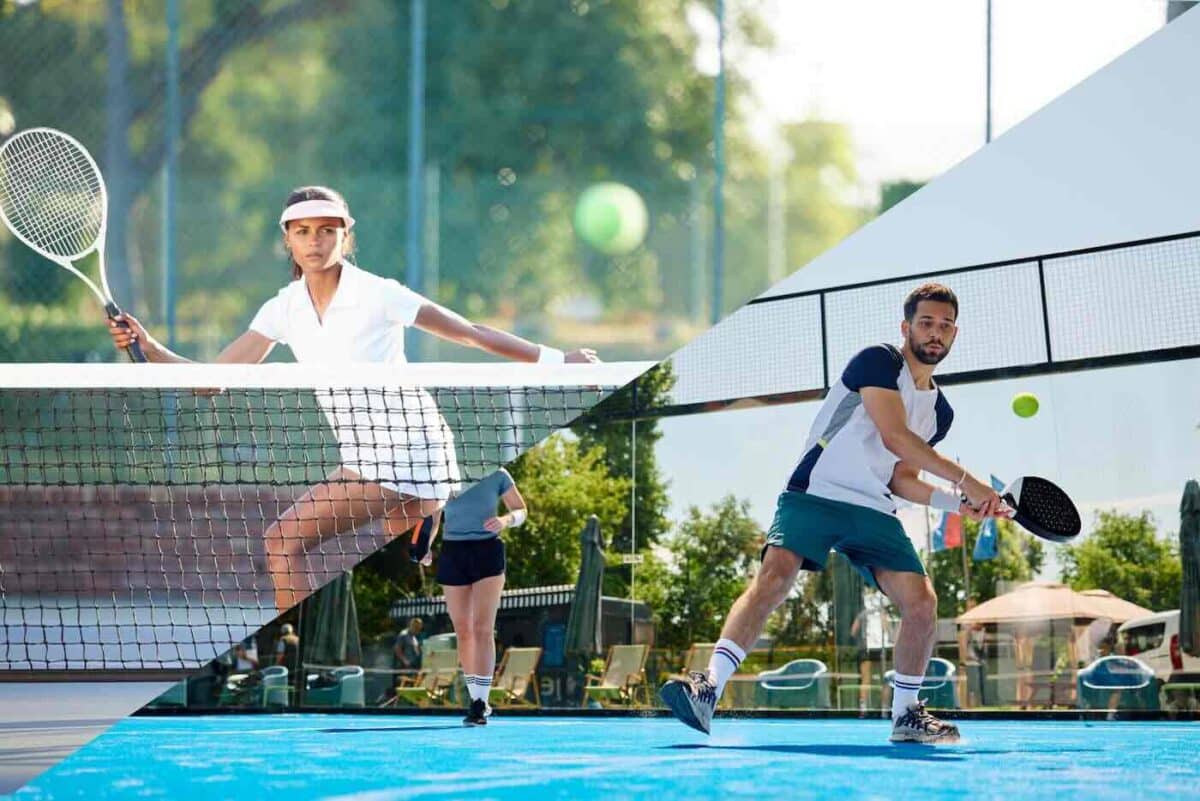
If you come from a tennis background, padel probably caught your eye because it looks familiar. Two sides of a court, a net in the middle, a fuzzy yellow ball. But step onto a padel court and you will quickly realize these are two very different sports. From the enclosed glass walls to the solid rackets, padel has its own identity, its own tactics, and its own learning curve.
In this guide, we break down every major difference between padel and tennis so you know exactly what to expect before your first match.
The Court: Smaller, Enclosed, and Totally Different
The most obvious difference between padel and tennis is the court itself. A padel court measures 20 meters long by 10 meters wide (roughly 66 x 33 feet), making it about 30% smaller than a standard tennis doubles court (78 x 36 feet).
But size is only part of it. Padel courts are fully enclosed by glass walls and metallic mesh fencing. These walls are not just boundaries; they are part of the playing surface. You can play the ball off the glass after it bounces, similar to squash. This is one of the biggest adjustments for tennis players because in tennis, once the ball passes you, the point is over. In padel, the rally keeps going.
The net in padel is also slightly lower than in tennis, sitting at 88 cm (34.6 inches) at the center compared to 91.4 cm (36 inches) in tennis. A small difference, but it affects how volleys and passing shots play out.
If you want to learn more about court specifications, check out our guide on Jak zbudować kort do padla.
Equipment: Solid Rackets vs Strung Racquets
In tennis, you use a strung racquet with a large head that generates power through string tension and racquet head speed. In padel, you use a solid racket (no strings) made from carbon fiber or fiberglass with a foam core. Padel rackets have a perforated surface with small holes drilled through the face.
The padel racket is also much shorter, typically 45-46 cm in length compared to a tennis racquet at 68-71 cm. This shorter length changes everything about your swing mechanics and reach.
For tennis players transitioning to padel, the compact racket feels strange at first. You generate power differently, relying more on placement and wall play rather than raw topspin and pace. If you are looking for your first racket, our Najlepsze rakiety do padla dla początkujących guide is a great starting point.
Padel Balls vs Tennis Balls
At first glance, padel balls and tennis balls look identical. They are almost the same size and share that familiar yellow felt covering. However, padel balls have slightly lower internal pressure, which means they bounce a bit lower and slower. This difference keeps rallies more controlled inside the smaller padel court.
You can technically use tennis balls for casual padel, but for proper play, dedicated padel balls make a noticeable difference. Check out our complete padel balls guide for recommendations.
Padel Shoes vs Tennis Shoes
Both sports require court shoes with lateral support, but there are differences. Padel shoes tend to have a herringbone or omni-directional sole pattern optimized for the artificial grass or concrete surfaces common on padel courts. Tennis shoes are designed for hard court, clay, or grass and have soles tailored to those specific surfaces.
If you only play padel on hard court surfaces, tennis shoes can work in a pinch. But for artificial grass padel courts (the most common type), proper padel shoes give you better grip and movement. We cover this in detail in our padel shoe guide.
Scoring: Same System, Different Feel
Good news for tennis players: padel uses the exact same scoring system. It is 15-30-40-game, with sets played to 6 games and a tiebreak at 6-6. Most padel matches are best of 3 sets, just like tennis.
The one twist you might encounter is the gold point (or sudden death) rule at deuce, which is used in some professional and tournament formats. Instead of needing two clear points to win a game at deuce, the receiving team chooses which side to receive and one point decides the game. This speeds up matches and adds drama, but it is not used in all formats.
For a full breakdown of how scoring works, read our padel serving rules guide.
Serving: Underhand Only
One of the biggest adjustments for tennis players is the serve. In tennis, the serve is a weapon. You toss the ball above your head and smash it with as much power and spin as you can generate.
In padel, the serve must be hit underhand. You bounce the ball and strike it at or below waist height. There is no overhead motion allowed. This means aces are extremely rare in padel, and the serve is more about placement and starting the point in a favorable position rather than winning it outright.
Tennis players often find this frustrating at first because a powerful overhead serve is one of their biggest advantages. In padel, that skill does not transfer directly, but your overall racket coordination and tactical awareness absolutely will.
Gameplay and Tactics: Walls Change Everything
In tennis, the baseline rally is king. You hit groundstrokes from the back of the court, work your opponent side to side, and look for opportunities to finish points with power or angles.
Padel flips this on its head. Because of the glass walls, the net position is dominant. The pair that controls the net typically controls the point. Rallies are longer, and brute force rarely wins. Instead, you use lobs, drop shots, and wall play to maneuver your opponents and create openings.
Some key tactical differences:
- Wall play: You can let the ball hit the back glass and play it on the rebound. This extends rallies and rewards patience
- Lob priority: The lob is one of the most important shots in padel, used to push opponents off the net and regain position
- Teamwork: Padel is almost always played as doubles, and communication with your partner is essential
- Less power, more placement: Hitting harder does not always help when the ball can come back off the glass
For a deeper look at shot technique, read our guide on Wyjaśnienie różnych ujęć padla.
Singles vs Doubles: Padel Is Built for Four Players
Tennis can be played as singles or doubles. Padel is almost exclusively a doubles sport. The court is designed for four players (two per side), and the tactical framework revolves around partnership and positioning.
While singles padel technically exists, the courts are too small for it to play well with just two people. The walls create too many angles for one player to cover alone. If you enjoy singles tennis, this is a significant mindset shift. Padel rewards collaboration over individual brilliance.
To learn about on-court positioning, check out our ostateczny przewodnik po pozycjach w padlu.
Learning Curve: Which Sport Is Easier to Pick Up?
This is where padel really shines. Padel is significantly easier to pick up than tennis, especially for beginners. The smaller court means less ground to cover. The underhand serve removes one of the hardest skills in tennis. The solid racket is more forgiving than a strung racquet. And the enclosed walls keep the ball in play longer, so rallies happen from your very first game.
Tennis has a steeper learning curve. Developing a consistent serve, generating topspin, and covering a full-size court takes months (or years) of practice. Many beginners struggle to sustain rallies early on, which can be discouraging.
That said, padel has its own depth. The wall play, positioning, and shot selection take time to master. But the floor for fun is much lower. You can enjoy a competitive padel match within your first few sessions. If you are just starting, our complete beginner’s guide to padel covers everything you need to know.
Fitness and Physical Demands
Both sports provide excellent exercise, but the physical demands differ. Tennis requires more explosive sprinting and endurance because of the larger court. Long baseline rallies and chasing down drop shots demand serious cardiovascular fitness.
Padel is more about quick lateral movements, reflexes, and agility. The smaller court means you do not sprint as far, but the rallies tend to last longer. Padel is also generally easier on the joints because the underhand serve and compact swing put less stress on the shoulder and elbow. If you have had tennis elbow issues, padel can be a more forgiving alternative (though it is not immune to overuse injuries).
For tips on staying injury-free, read our article on the most common injuries in padel.
Padel vs Tennis: Quick Comparison
| Feature | Padel | Tenis |
|---|---|---|
| Court size | 20m x 10m (66 x 33 ft) | 23.8m x 10.97m (78 x 36 ft) |
| Walls | Yes (glass and mesh) | No |
| Racket | Solid, no strings, 45-46 cm | Strung, 68-71 cm |
| Podawać | Underhand only | Overhead |
| Scoring | Same as tennis | 15-30-40 system |
| Format | Almost always doubles | Singles or doubles |
| Ball | Lower pressure | Standard pressure |
| Learning curve | Easier for beginners | Steeper |
| Dominant position | W sieci | Baseline |
| Physical demand | Agility, reflexes | Endurance, power |
Should Tennis Players Try Padel?
If you play tennis, you already have a head start in padel. Your hand-eye coordination, understanding of angles, and court awareness all transfer over. The transition is not seamless though. You will need to unlearn some habits (like trying to overpower every shot) and develop new ones (like reading the ball off the glass).
Many tennis players who try padel find it addictive. The social aspect of always playing doubles, the fast-paced rallies, and the lower barrier to having fun all contribute to padel’s rapid growth in the US. Courts are popping up across the country, and finding a game is getting easier every year.
Ready to find a court? Check out our guides on where to play padel in California, Teksas, Miamioraz Karolina Północna.

Lucas Sánchez jest założycielem SimplePadel. Urodzony i wychowany w Hiszpanii, Lucas mieszkał w Stanach Zjednoczonych i Wielkiej Brytanii przez ostatnie 20 lat, a obecnie nazywa Miami swoim domem. Choć nigdy nie grał zawodowo, jego marzenie jest wciąż żywe.
Lucas uwielbia grać (i rozmawiać) w padla i uważa się za szczęściarza, że ma żonę i rodzinę, którzy podzielają jego miłość do tej gry.